Showing posts with label Psychological. Show all posts

Tuesday, 29 December 2020

Skinner

I think we have to consider ourselves lucky as film-collectors in the UK.  Skinner (1993) was nigh on lost if it were not for the efforts primarily of its writer Paul Hart-Wilden (along with help from others along the way), added to the fact that the BBFC would once have ruined this with censorship (they've today decide to mercifully leave it complete), as well as the chances of today's easily offended factions of society having something to be offended at being quite high (unfortunately that kind of whining has way more sway than it should, post millennium).  And then factor in that this is now mastered in 4K from an uncut source and put out - with decent extras - on Blu-ray, in the UK as technically the best edition in the world and ever (!), is all in all a miracle to behold.

In essence a tale about a serial-killer, back when they were quite popular on film, Skinner follows around the titular character (Skinner by name and nature - Ted Raimi) as he continues a compulsion to kill and remove/wear his victims' flesh.  Complicating matters is the detail that one of his former victims (a very tragic portrayal by Traci Lords) still lives.  Badly scarred she now seeks out Dennis Skinner in order to eventually execute her own revenge.  Along the way he lodges with an appealing young woman (Ricki Lake, surprisingly), forming a half-complete relationship with her while her husband takes immediate dislike to both the man and the boarding situation.  It's not quite hitting all the nails that could have made this a genuine cult classic, but it's not a million miles away from that classification either.  What I do like about it is its feeling of being a little bit underground, a bit sludgy and taboo.  It's quite nasty in places (very nasty in one particular prolonged sequence), not too fussed about pushing a few buttons as things weren't back then, and quite uniquely grim.


101 Films picked this up for UK distribution and added a few bells of their own.  Firstly the transfer is excellent, widescreen and sourced as mentioned above from a new 4K master using unrated elements that were very close to never seeing the light of day again.  There was once a very rough DVD of the film (succeeding prior VHS tapes and a LaserDisc), the only factor retaining value being its 4:3 presentation (i.e. opened up, as opposed to matted on the new edition).  But of course this new master, most likely now framed as intended, is leaps above anything else in terms of image colour and detail.  Shared with its US (Severin) cousin disc, there's a 20 minute interview with Hungarian-born director Ivan Nagy (shot around 2007 before his death a few years later) where he talks about how he got into directing and what he thought of the script, etc.  His controversial relationship with Heidi Fleiss is more than touched upon too (interestingly, the pursuing woman once nearly killed by Skinner was called Vicky in the script, but renamed Heidi in the filmed version...).  Ted Raimi provides a 15 minute interview where he expresses appreciation for being a part of the film.  The writer himself delivers a 17 minute insight into what he was thinking when he wrote the film and the story of the script essentially being taken away from his (London-bound, self-shooting) intentions through to loss and rediscovery.  Then we have a 10 minute piece that's a lot more fascinating than I expected it to be, a talk with the lucky guy who brought the elements back together in the 90s in order to cut (or recut) it for its then distributors.  Rounding out the extras on the discs are a 14 minute time-coded selection of outtakes from the brutal skinning sequence that centrepieces the film's horror statement, plus a trailer of course.  Aside from Severin's (who shot/compiled the extras footage) tiring inclination to repeatedly insert shots from the film as interviewees talk (e.g. someone mentions a door closing, cut to a shot of Ted Raimi in front of a door...), i.e. I would really just watch the interviews uninterrupted with pointless footage from the pertinent movie, this is a fantastic selection of talks from the people involved in Skinner.

But wait... here in the UK 101 released this (dual format Blu-ray and DVD) as part of their premium Black Label, whereby the standard edition is embellished with a quality slipcase and booklet containing (alongside stills) a fantastic essay by Paul Hart-Wilden detailing his blossoming interest in relocating the elements to Skinner and the arduous decade-long search that ensued, culminating with how it finally landed on Blu-ray in the beautiful edition that we have here.  If you are in the US the Severin disc will probably suffice, but 101 have edged it by putting out the best edition worldwide.  It's also available as a standard version here in the UK for when that Limited Edition goes out of print, but I would grab the LE if I were you.

Monday, 7 November 2016

Hourglass Sanatorium

Or Sanatorium pod Klepsydra as it would have been known in Polish, directed by Wojciech Has.  This will be a hard film to digest for most viewers I would imagine, but I decided to give it a go nonetheless.  The plot is almost impossible to describe, but to attempt a synopsis: a traveller arrives at a dilapidated building where his father has died, or is about to die...  There he is told by a doctor that time operates differently and whilst his father may be dead from where Joseph has travelled, that's not necessarily the case here.  Joseph then proceeds to traverse deeper into a dreamlike world from one strange locale to another, from one odd encounter to the next.

A near overwhelming exercise in surrealist cinema, Hourglass Sanatorium is a film that lives outside of the time (1973) in which it was made.  I have to admit that most of the symbolic imagery goes over my head, and perhaps this composition of subversive ideas is something that academics will revel in.  Despite its long running time (just over two hours) I think it's worth the rest of us sticking with, because the final scenes suggest what's going on with the lost soul of Joseph.  I understand the film is also allegorical of the Jewish plight during the thirties and forties although again I am not knowledgeable enough on such historical matters to appreciate the film in this respect.
What I can say is that the imagery contained within is extremely powerful - the cinematography combined with production design is a monumental achievement all round, with rich and evocative visuals playing on the senses in almost every frame.  The sound design is also notable in its ability to construct atmosphere.  I do hope to revisit the film again with the aim of deciphering its esoteric narrative details.

British company Mr Bongo have recently put the film out on disc, and I picked up the Blu-ray for this viewing.  It is extras-free unfortunately - I say that because often films that don't really need much explanation arrive with plenty of interviews, etc., whereas something that could really do with some insightful exposition comes along with nothing at all.  Then again, it could be said that this might encourage people to interpret the material themselves, though I suspect most contemporary viewers are a little too lazy for that.  The 1.85:1 full HD image on the Blu-ray is exemplary, with enticing detail/chromatics supported by what is likely to be the best possible audio given the era of production (it's here in DTS HD MA 5.1 but the sound really is centred largely at the front).  Audio is Polish language only, with excellent English language subtitles.  As an import option, there is also quite a nice Polish digibook edition which is English-friendly (apart from the bundled Polish booklet) and can be picked up for a reasonable price at time of writing.

One to give a chance if you're feeling brave and experimental - if so, the Blu-ray is the way to go.

Monday, 22 August 2016

Death by Invitation

The prologue depicts a young woman, suspected witch, being flayed by a horde of medieval people, themselves in some cases decorated in almost a devilish fashion.  In the present day someone who resembles the woman, possibly her ancestor, infiltrates a family consisting of the killers' descendants, the intention apparently being one of cross-generational vengeance.

A little known film by Ken Friedman from 1971, Death by Invitation is an intriguing study of a psychologically disturbed woman driven to kill by events that may have occurred aeons previous.  I say 'may' because I feel there are elements of ambiguity in all of this - either she is the descendant of a witch that was killed by Catholics (and, indeed, there is a brief hint that the religion has been passed down to the family in the present day), or she is deluded into thinking this is the case by her own paranoia and misandry.  Or perhaps she is the actual witch herself, who has survived for hundreds of years to now finally discover or locate her opportunity to end an extended lifetime of bitterness.
It's a plodding piece, underpinned by an air of feminism that I wouldn't ordinarily have much sympathy for in the post-millennial Western world, however, the concept overall is not without its interest.  Moreover, the lead character - the first known role of actress Shelby Leverington - is fascinatingly sexual and disturbed.  Leverington is quite incredible, both for her mysterious, acute portrayal of Lise, and for her alluring sultry persona.  She may not appeal to all but I found her to be hypnotic throughout, especially during her intense pre-murder delivery of a historical monologue that her character may have been witness to in some way, or have an obsessive belief in - despite this being pure talk it is a captivating and vivid sequence.

Having had very minimal exposure to the public in the past via home video (and possibly a brief theatrical run?) Vinegar Syndrome unearthed this for what could be its final lease of life, a double bill DVD, part of the Drive-in Collection, with Dungeon of Harrow (previously it was doubled with 1979 slasher Savage Water before that ran into trouble and was quickly withdrawn from circulation - a handful of copies are out there but you can guess what people are asking for them).  Death... is presented on DVD at 1.85:1 from a fairly scratchy print, battered, but looking better than it ever has (and, shamefully, possibly ever will).   It comes with an audio commentary from the Hysteria Continues pod-casters.  Unfortunately this does not offer a great deal of useful information about the film, sometimes consisting of the commenters merely passing thoughts about the décor or fashion (yes, people, this was 1971 - the stuff that you're wearing will no doubt also look like a joke in forty years!  Or possibly less).  Justin Kerswell comes off as an intelligent chap, often bringing things back on to track.  Aside from the occasional amusing comment or slice of insight, the commentary is not how I'd like to remember the film.  On the other hand, the sitting-with-one's-mates-watching-a-film type of scenario might appeal to some.  In summary though, this is a good disc to own and one much appreciated from the stellar organisation that is Vinegar Syndrome.

Thursday, 11 August 2016

Lovely Molly

The beginnings of a potentially happy marriage are lashed after the temporarily elated couple move into the parental home of the bride.  Elements of the father's death and relationship with his daughter remain a mystery - this may or may not have anything to do with the events to come.  Molly's husband, Tim, works away from home frequently and it's during these absences that unusual activity in the house begins to occur, possibly of a supernatural origin.  Molly reverts to a former drug addiction, beginning to psychologically deteriorate under the stress of matters.
Underpinned by a poignant performance from Gretchen Lodge as Molly, I wouldn't say the film is an enjoyable experience, but it does function effectively.  The source of the trouble remains under an ambiguous cloud, which may not suit everyone - is it the spirit of her dead father returning to deliver otherworldly torment, could it be the diminishing grasp on reality of a fragile mind, or is the Devil tearing through to the physical world to claim a broken soul?  Or something else?  I personally like the fact that the viewer has to make up his or her own mind about the proceedings.  Many Paranormal Activity-type occurrences outline possible traditional haunted house goings-on, and in this alone it could be said there is a lack of originality, but the film saves itself through its descent into very disturbing territory.  My blood was chilled for some time after viewing, though I'm not sure if I'll be rushing to go through this anguish again.

I'm not a fan of the digital video look, exhibited here.  There is banding and unattractive chromatics alongside reasonable levels of detail, probably captured as-is by the UK Metrodome Distribution Blu-ray.  Image is 1.78:1, surround sound almost having too much impact.  The disc contains a number of featurettes about the production along with a trailer.  Directed by The Blair Witch Project helmer Eduardo Sánchez, Lovely Molly (2011) can certainly not be criticised for leaving its viewers in an overly cheery state - watch at your peril...

Monday, 8 August 2016

The Sender

After attempting to take his own life a young troubled man winds up incarcerated in a mental institution under the care of an inquisitive psychiatrist.  Trying to help, she is traumatised once she finds that his subconscious chaos is projected on to others in times of stress, causing vivid, undesirable hallucinations in those around him.

Exhibiting shades of Patrick, The Sender (1982) is not exactly directed in an urgent fashion, plodding along without eliciting too much excitement along the way.  Having said that, I did experience one or two moments of unease, plus there is a standout sequence where mayhem explodes during quite a perturbing attempt to 'cure' the young man of his problems.  The female lead, Kathryn Harrold as Gail Farmer is also extremely appealing, combining a subtle, striking beauty with intellect and maternal instinct.
Olive Films, who have released this on Blu-ray in the US, are both greatly appreciated (for the fact that they put catalogue films out on Blu that many other companies wouldn't be bothered with) and in equal measures frustrating (because those films often come without any bells).  The film is presented 1.78:1 and has all the markings of an old transfer - looks reasonably good in many broad daylight sequences, often a bit drab during darker moments.  Overall it's okay, the benefits of a complete overhaul probably not on the horizon.  The sound exhibited a lot of hiss and weakness that I'd associate with an inadequate source.  I suspect the whole thing is taken from an aged 35mm print, and scanned some time ago, although please correct me if you know otherwise.  Still, it's a little better to view this movie here on Blu than either the old DVD that Legend Films put out in 2008, or the concurrent DVD that Olive themselves have released.  On the extras side there is nothing (aside from menu and chapter selection) - it's like going back to the VHS days!  If you're picking up the film for the first time you may as well go with the Blu, however, if you already have the Legend DVD then Olive have not done a huge amount to persuade you to upgrade.

Tuesday, 13 January 2015

Anguish

An interesting oddity dating back to 1987, and shot in Barcelona, Anguish (or Angustia, or Im Augenblick der Angst) begins with an uncomfortable depiction of a grown man's homicidal tendencies combined with his close, possibly psychic relationship with his creepy mother, before revealing that this is a film playing in an American cinema.  Some of the viewers become increasingly disturbed by what they're watching on screen, before events in 'real' life begin to imitate those of the celluloid they're experiencing.
What I particularly liked about Anguish is the manner in which it blurs the lines between reality and cinematic fiction, crossing over the events of the two worlds with gradually heightening frequency and intensity.  Whilst it can be uncomfortable viewing at time, with some particularly gruesome sequences spattered throughout (and a little unnecessary animal cruelty in my opinion), the film's fascinating tightrope walk between supposed realities, combined with occasional surrealism, result in an original piece of work, that is often bizarre, captivating, and will beg to be watched repeatedly, until you yourself succumb to its spell of demented hypnosis...

The Germans, as usual edging ahead of many other countries in their selection of enticing catalogue titles for Blu-ray, have put out Anguish (as Im Augenblick...) with an excellent 2.35:1 full HD transfer, and a choice between English (naturally, as shot) DTS HD MA 5.1 or German in the same mode.  German subtitles are there of course, but thankfully they are removable.  At 24 frames per second it runs about 85 minutes.  At times boasting the feel of a classic Dario Argento exercise, the sound mix of this film is really important, reminding me in some ways of the direction they took with Berberian Sound Studio, entwining intricate sound patterns with a deliberately confused transition between realities for both the protagonist and the viewer, and headphone-use or surround listening is encouraged.  The cover is reversible - effectively the same artwork but without the red banner at the top, and missing the huge age restriction that seems to emblazon all German disc releases.  Needless to say it was turned around instantly upon opening...  The disc also comes with an interview and trailers - not exactly padded extras-wise but the very fact that something like this appears on Blu in such an attractive audio-visual presentation is to be rejoiced.

Saturday, 8 November 2014

Sleepwalker

Sleepwalker was made in 1984 by a promising film-maker called Saxon Logan.  It's a politically underscored drama about two obnoxious couples who after an evening meal head back to stay the night at the rotting house owned by one of them.  Unfortunately one of the group is afflicted with violent somnambulist tendencies and the night will end in tragedy.  Running at only 50 minutes in length Sleepwalker is about right in its pacing.  It's a thoroughly British affair, although the characters are hardly an attractive representation of our over-filled island.  There is a fine air of decay, particularly in the home (English man's castle...?) and as the story threads its way to the finale it is evident that some influence emanates from the Italian giallo cinematic movement.  There is also a reminiscent touch of the TV series Hammer House of Horror - I feel that Sleepwalker could almost have been a part of that series.

The Rank studio did not take well to the film back in the mid eighties, putting an end of Saxon Logan's fiction movie career before it really got started, but it's heartwarming that it was later rediscovered (thanks partly to Kim Newman arousing interest in the then-forgotten film some time ago).  It's wonderful that BFI have taken films like this to exhume for the more open-minded among contemporary audiences, as it has recently been scanned and mastered for Blu-ray, with excellent results.
The BFI release is also packed with two of Logan's earlier short films also mastered in HD (Stepping Out running at 11 minutes and made in 1977, plus Working Surface, 16 minutes, 1979), which are curiosity pieces making the package feel very complete as far as Logan's fiction work is concerned (he went on to cement himself as a documentary film-maker).

However, BFI have also kindly included another film which, whilst not made by Logan, is thematically linked to the main film in the pack.  Running at 45 minutes the 1971 film Insomniac is the only fiction work directed by Rodney Giesler (also a documentary maker).  This is about a very average sort of man whose initial difficulty sleeping leads him to enter a lucid dreamworld of perpetual daylight and populated by people who exhibit an aversion to light.  At a party he meets the perfect female before eloping with her.  The surreal aspect of this film I feel could have been pushed a lot further, though it is a nice piece that could easily have been left buried forever.  The primary strength of the film arrives in the presence of the vividly beautiful Valerie Ost (who also appeared briefly in Corruption, Satanic Rites of Dracula, and a few Carry-On films in bit roles).

The menus of the disc provide options to watch all three Logan films or a double bill of the two main features if you wish.  You'll also find a 72 minute conversation from 2013 with Saxon Logan where he talks about his inspiration (Lindsay Anderson, Hammer films surprisingly, and even more of a surprise is his appreciation for giallo), his education in the mechanics of making films, his experiences making the films contained in this pack, etc.  It's a fascinating piece with none of the press-kit approach rubbish you find as extras to most mainstream films.  Logan is a coherent, level-headed talker who had talent but couldn't quite take it where he wanted due to the fact that his work wasn't really understood at the time.  The occurrences pertaining to the screenings of Sleepwalker, both at the time of its release and the rediscovery years later, are obviously deeply meaningful to the man, something underlined by a particularly poignant moment towards the end of the conversation when he struggles to contain the emotions that are obviously packed inside.  A brilliant, essential interview for anyone interested in film, almost worth the price of admission alone.

Not content to leave you with this, BFI also include an attractive booklet presenting written pieces on each element on the disc, with transfer information and stills.  The films are also provided on a DVD in the same pack, but as they were scanned at 2K they really are best viewed on Blu-ray for the most authentic representation.  Sleepwalker and Insomniac generally won't appeal to the average mainstream movie fan, but for those interested in the heritage of British cinema, more arthouse oriented viewers, or possibly even fans of the giallo, this is a great package to have in your collection.

Sunday, 24 March 2013

Touch of Death

Quando Alice Ruppe Lo Pecchio (which translates as When Alice Broke The Mirror rather than Touch of Death as it's better known to English speakers) was made around the same time as Sodoma's Ghost (1988) for the same producers.  It's about a man with serious gambling issues who is compelled to date and murder rich women to fund his downwardly spiralling lifestyle.  It would appear that his mind is losing its stability in the process, as he believes odd things are happening with his own shadows, conversations occur with himself, and most uncannily, people he has killed are indeed found dead - but not where he left them.  Furthermore the police seem to be closing in as clues to his identity materialise on the News with alarming frequency.
As with Sodoma's Ghost Fulci wrote the story and screenplay for this one, though his efforts are more successful here than the dire Naziploitation flick.  Carlo Maria Cordio's score is stronger, though still a tad excessive, and the dialogue appears to be improved (though it's difficult to directly compare due to the fact that I couldn't view Sodoma's Ghost in Italian, as previously mentioned).  There are doses of humour varnished on to the horrors (e.g. the feet of a recently murdered corpse keep popping out of his car boot, until he resorts to chopping them off!) that occasionally function as intended, but what keeps your eyes on the screen is the presence of the downright bizarre.  Every woman he tends to get his mitts on is remarkably ugly, even to the point where one of them has a scarred face that he can barely even look at (and as plain wrong as it is, this scenario actually forces a couple of smiles that you'll be desperately trying to suppress).  Surprisingly the film is incredibly gory (I say surprisingly because I believe it was made for television), one scene early on reminding me of some of the atrocities in Guinea Pig II, which is kind of pleasing given Fulci's history with some of the best gore films to ever come out of Italy, however, special effects man Angelo Mattei is no Gianetto De Rossi.  Having said that the head in an oven is a bit of a show-stopper.  Exploitation regular Zora Kerova (Miss Meathook from Cannibal Ferox) is also present.

The Dutch DVD from EC Entertainment gives us a soft, washed-out fullframe (framed as shot on 16mm) transfer, with optional English or Italian audio tracks.  Thankfully there were English subtitles available, although the Italian track is in quite bad shape (I've heard forties films sounding better than this).  Shriek Show released a DVD a couple of years after this one, looking much the same although featuring a more comprehensive package of extras.  Make no mistake: this is not an excellent film, though I do feel there is enough of the macabre and weird here to save it from the dust-bin (garbage can if you're American).

Thursday, 7 March 2013

They / Cursed - Miramax Blu-ray Double Bill

Firstly, the films: Cursed is a Wes Craven directed, Kevin Williamson written werewolf flick from 2005. It's widely acknowledged that there were significant production issues that may or may not have damaged what Cursed was eventually to become. It's basically about a teen brother/sister duo (the latter being Christina Ricci) who become infected by a werewolf following a road accident. It keeps you awake, but I was fairly disappointed with what the talented Craven/Williamson duo have put together here - it feels like it's desperately trying to be hip in its attempt to do for werewolf films what Scream did for slashers.

I've seen They a few times on DVD and whilst it's easy to dismiss it as a pretty generic contemporary shocker, I do quite like it. Focusing on youngsters who have experienced night terrors (extremely vivid and often violent dreams that can result in somewhat unwanted physical activity) that have left lasting scars, we find that these issues are now manifesting themselves in the characters' adult lives, with fatal outcomes. This results in the appearance of hostile alien-like creatures whose apparent objective is to drag their victims off to some hellish netherworld. Whilst `they' appear to be real, it could be theorised that whenever the characters are witnessing the emergence of these monsters, they're actually experiencing the very night terrors that plagued them as children, i.e. they're still dreaming (an idea supported by the bathroom incident with Julia, where her experiences in the bathroom are followed by her being `woken' by her boyfriend, and Julia not actually remembering entering the bathroom at all). It could also be theorised that the creatures have been given physical birth somehow by the power of these people's dreams. I think that's one of the things I like about the film - it does stimulate some thought, and the atmosphere is often quite subdued and dreamlike.
The first thing to know about the Miramax double bill is that it's locked to region A (i.e. the US standard), so it won't play on most UK machines (unless multi-region capable of course). Both PG-13 rated films (the equivalent of our 12 rating; always undesirable when it comes to 'horror' movies...) are on one disc, though they average around the 90 minute mark each so even with extras it's not a great push for Blu-ray's 50Gb capacity.  Although the packaging states plain old DTS for audio, both films come with DTS-HD MA tracks, either in 2.0 or 5.1 variants. Cursed pleasingly looks and sounds very clean with a very light layer of grain, although it is inexplicably presented in 1.78:1, compromising its OAR of 2.39:1 - if the film had been more important I would have been concerned, but I still find this decision strange.  There are about 25 minutes worth of featurettes as bonus material for Cursed.  I understand that this film has been available in an 'unrated' variety stateside, though having not seen it before I can't comment on differences.

They is thankfully presented in its OAR of 2.39:1, looking quite drab, however, this appearance may be a symptom of the cinematographic approach. I made some direct comparisons to the UK EIV DVD: the Blu-ray runs at the correct speed (24 fps) as opposed to 25 fps on the PAL DVD (running time approximately 90 minutes on Blu, 86 minutes on DVD), it features a slightly meatier lossless audio choice instead of plain old Dolby Digital (again a 2.0 or 5.1 choice) on the DVD, both discs feature an alternate ending as an extra, but the Blu-ray also has some deleted scenes. Also, there is a little extra visual information at the sides of the widescreen image on the Blu-ray. Contrast is higher on the DVD (whether artificially boosted or not I cannot say) but fine detail is noticeably superior on the Blu-ray (to illustrate, the nice overhead shot of Julie walking into the diner to meet with estranged ex: the blinds of the diner window are clearly defined in HD, whereas they're a bit of a blurry mess on the DVD). Aside from the reduced contrast which loses the image some possible vibrancy, the Blu-ray of They is all round an upgrade over DVD.

Monday, 27 August 2012

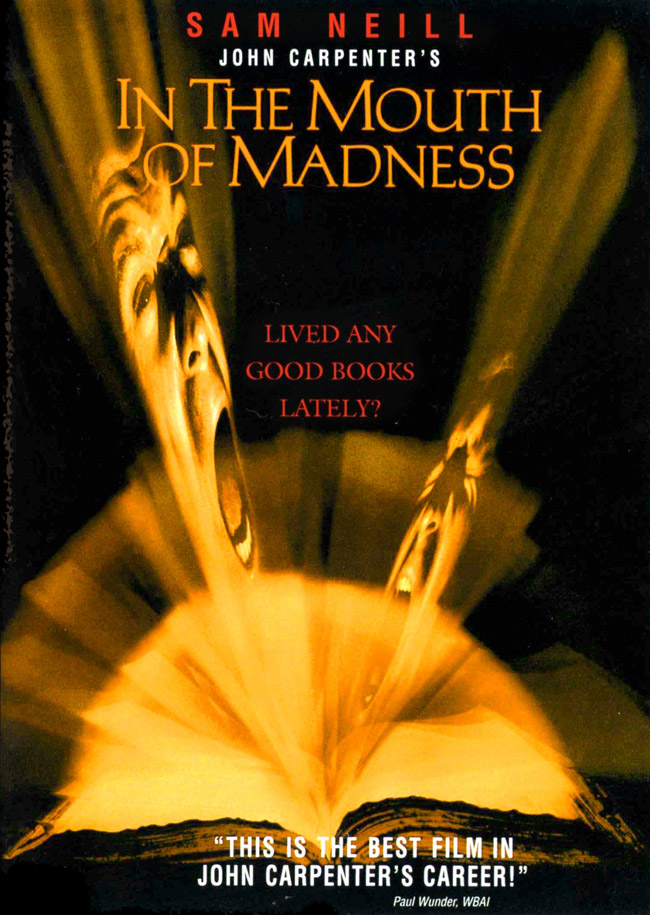
In The Mouth of Madness


Insurance investigator John Trent is dragged struggling into a cell within an institution for the hopelessly deranged. Visited by one Dr Wrenn he recounts his story: months ago he was hired to investigate claims made by a book publisher for the disappearance of one of their most prominent writers of terror novels - Sutter Cane. Sniffing a publicity stunt on the eve of the release of one of Cane’s most anticipated books Trent begins scrutinizing the situation more closely. After the meeting with the publishers he picks up a number of Cane’s books to see if there’s anything to fathom from those, however the perpetually sceptical man soon finds himself being drawn into the illusion of Cane’s supernatural domain as he spends the next day or two reading. Realising that the covers of Cane’s books contain a hidden map, presumably offering a clue as to the author’s whereabouts, Trent sets off on a long drive with one of the publishing assistants despite not being aware of precisely where Cane’s possibly fictitious town is. However, after a couple of days of driving and a number of odd encounters on the road they arrive at the place which, as far as any map is concerned, doesn’t exist - Hobb’s End. As strange occurrences begin to increase with frequency it appears to Trent that the possibilities of a publicity stunt were left behind long ago, and in its place is an uncanny nightmare that almost suggests that Cane has created everything that is happening. Or Trent has gone insane.
Amidst Carpenter’s erratic career those consistently familiar with his work often agree that there is a roughly fifty-fifty split between the genre busting classics and the oddly misfiring projects that a seasoned director would be expected to do something a lot better with. Whilst everybody agrees that, for example, The Thing is amazing and that Ghosts of Mars sits at the other end of the extreme (yeah?) there are some that mix opinions, In The Mouth of Madness from 1995 seemingly one of them. Sam Neill and his misjudged American accent together take on the role of John Trent, but I think considering the fact that he’s experienced and generally capable he doesn't pull it off completely convincingly. There’s something that doesn't quite work about him and it’s one of those things that you have to learn to live with if you’re going to be watching this more than once. Julie Carmen (the aristocratic vampire chick from Fright Night Part 2) thankfully tags along as his sidekick for the journey and brightens things up a touch, while other more renowned stars have brief (probably financially dictated) appearances here and there: most notably David Warner as Wrenn and Charlton Heston as the publisher.

The film’s story confronts the idea that gruesome fiction can warp the minds of its followers, or at least that’s what it appears to be confronting although if this is a moral angle of some kind I see it as a slightly hypocritical ideal - preaching the pitfalls of horror on the human mind within a horror vehicle designed to entertain. Aside from this hiccup the movie winds up being one of the best interpretations of H.P. Lovecraft’s worlds of terror that’s not actually based on any specific Lovecraftian work. It sort of welds Stephen King to Lovecraft (the antagonist, Cane, representing the former, the domain he creates representing the latter) with a degree of success. Trent’s largely retrospective story is told from the cell of an insane asylum (a characteristic of many Lovecraft stories) as he recounts how the world outside began to go crazy during the release of Sutter Cane’s latest novel to a blood-hungry public. In flashback he recalls noticing a thriving aggressive madness swelling around him as interest in the book became feverish, his own understanding of reality beginning to break down as he investigated the disappearance of the author - there are shades of Videodrome here (confusion of where the line between fantasy and reality lies resulting from immersing oneself in some form of entertainment). His trip into the fictitious town that may or may not have been created out of the imagination of a man is suitably nightmarish and one of Carpenter’s best realisations of the essence of terror in film. Illustrations of this include the strange geriatric cyclist who’s really a boy that can’t escape Hobb’s End, a sadistic old lady who mutates into a multi-tentacled monster, a psychotic crowd of children, Trent’s repeatedly unsuccessful attempts to escape the homicidal townspeople, etc. As with a number of his other projects, Carpenter was heavily involved with the music and this really announces itself over the lead titles as pounding metal guitar accompanies images of a printing press producing thousands of books that will eventually spread insanity across the globe. Therein lies the apocalyptic thread that flourishes throughout much of the director’s other material - The Thing, Prince of Darkness, Escape From New York… What I ultimately love about this movie is its inherently inexplicable nature, something substantiated by the conclusion - leaving the horrifying without explanation grants it the power to tantalise. It’s possible that Trent investigates the author’s absence and goes mad in the process, but this is only one possibility and, as usual, I enjoy this kind of ambiguity.

Unjustifiably this has never reached the UK on disc. Back in the nineties good old EIV put out a cropped fullscreen tape (which I believe was later followed by a widescreen version). It’s common knowledge that Carpenter prefers shooting in anamorphic Panavision (2.39:1) and his visuals always look unreasonably compromised when dissected in such artistic blasphemy. The US DVD was released years ago by New Line and contained both wide and fullscreen options (allowing the viewer to make comparisons to identify just how butchered a cropped Panavision image is in fullscreen), a trailer and a commentary from director and cinematographer.  Later on a Blu-ray was thankfully let out on to the US shelves, again by New Line - the HD image (only the widescreen option on this disc) is noticeably superior to the previous editions in every respect, and projected on to a large screen looks really cinematic.  Sound is given a boost also with DTS HD MA, while it's appreciated that the commentary has been retained.  I am somewhat doubting there will ever be a truly special edition, but in terms of its excellent transfer, this Blu-ray is the only sensible way to buy and watch In The Mouth of Madness.