Showing posts with label Italian Horror. Show all posts

Sunday, 15 December 2024

Castle of Blood

Castle of Blood (AKA Danza Macabra) from 1964 continued in the footsteps of Mario Bava in forging a path through Italian Gothic Horror territory, and quite effectively so.  The story begins with travelling journalist Alan Foster stopping off at an inn to interview author Edgar Allan Poe, who he finds regaling other drinkers with his tales of uncanny strangeness (which he professes are all based on true events).  During the ensuing debate, Foster accepts a bet to stay in a supposedly haunted castle where people tend to wander into, but never back out of.  Sceptical Foster leaves the others at the gates of the house, ventures inwards, and is accosted by unusual events.  These culminate in a ghostly re-enactment of a jealous murder aeons ago, the two worlds crossing over leading to one of the women of the event (Barbara Steele) becoming romantically entangled with Foster.

It's a lovely piece of work from Antonio Margheriti, shot in startling black and white and featuring a wonderful gothic castle throughout which most of the action takes place.  Steele made a name for herself in these types of films, starring in the alluded to (above) Mask of Satan (Black Sunday) and another similarly-styled project with Margheriti just a short time later (The Long Hair of Death).  Most of these Steele films at time of writing have materialised on Blu-ray or 4K (the notable absence being The Ghost (Lo Spettro), Riccardo Freda's very loose follow-up to the legendary Horrible Dr Hichcock.

Released a number of times over the years, I'm focussing on three discs in particular here.  The recent 4K/Blu-ray edition from Severin Films, an earlier Blu-ray from Severin again (the film essentially being an extra on their Nightmare Castle release), and a much earlier DVD from Synapse FIlms.

In terms of presentations, the new Severin provides both the Italian Danza Macabra and US Castle of Blood cuts.  These run 90'10 (after removing tech notes preceding the film) and 82'56 respectively.  The former Severin Blu-ray was only Castle of Blood running 82'27, while the Synapse was a hybrid that approximates the European version, running 89'01.  The earlier discs were 1.78:1 framed, while the new Severin is (most likely) a more accurate 1.85:1.

Language options are Italian for Danza... on the new disc (with English translated subtitles) and English for Castle... again on the new disc.  The former Severin Blu-ray was English language only, while the Synapse was English for the most part, switching to French (with English subs) for the extra scenes.  There is a full French track on the Synapse DVD but this is unfortunately not subtitled.

Picture quality was reasonably good on the old Synapse, Don May Jr. being adept within the confines of each format he has worked with.  The previous Blu-ray from Severin was very rough, appearing to be taken from an unrestored theatrical print - scratchy and damaged throughout.  I imagine this (along with the sound - see below) is why it was only included as an extra rather than sold as a standalone feature.  The newer Severin release is pleasingly a substantial upgrade, with more detail, more shadow detail, and a beautiful grain field resolved nicely throughout.
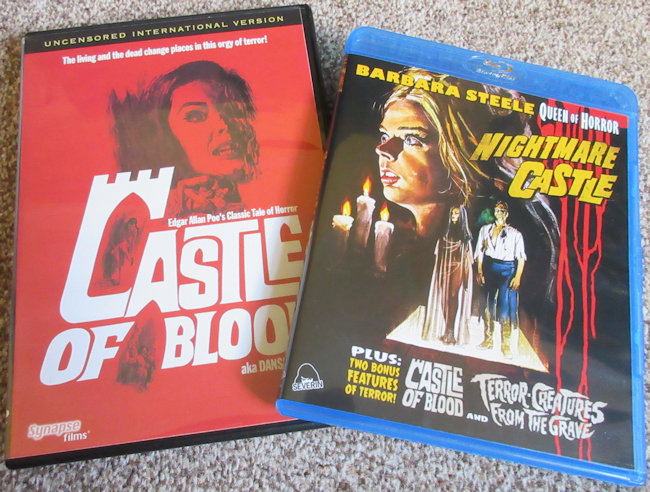
It's a similar story with the audio quality - Synapse had cleaned up the sound though it's slightly muffled by today's standards, the older Severin Blu-ray was quite bad featuring distortions, hissing, crackle, etc.  The newer 4K is excellent: clean and very audible.  Obviously all of these presentations are effectively mono.  Interestingly, the Severin releases utilise credits that take place - inappropriately in my view - over a shot of then-modern day London, whereas the Synapse credits are more obscure (the London credits are included as an extra).

The new Severin set's extras include an engaging 15 minute chat with Margheriti's son (obviously the great man is dead now), a 20 minute return to the shooting location for parts of the film, a wonderful 5 minute chat with the charismatic director himself (shot for an article elsewhere), and a half hour piece on Steele's Italian gothic period by Rachael Nisbet, which unfortunately descends into the usual obsessions with identity politics, historical 'female oppression', and - wait for it - 'patriarchy' that almost all female critics seem to salivate over, reading the same tropes into everything they watch and attempting to pollute the minds of others with their own warped outlook along the way.  Much more engaging is the talk with ever-reliable Stephen Thrower, who delves into more varied details about the film.

It's a relief to say that the Severin 4K release, both standalone and previously included in their Danza Macabra Volume 2 The Italian Gothic Collection, is as definitive as I can imagine it, with a fantastic video and audio presentation that thoughtfully includes the two main edits of the film (plus English translated subtitles!) alongside a reasonable supply of extras.  The former Severin Blu-ray is atrocious but to be fair, as mentioned above, it was a supplemental feature to Nightmare Castle, which looked good.  The Synapse DVD is not without its value, being a decent way to experience what approximates the European cut in mostly English.  As it stands though, the new Severin 4K is now my go-to option for this minor classic.

Thursday, 28 December 2023

Black Magic Rites

In attempt to cobble together some sort of summary:  Several hundred years ago, Isabel (Rita Calderoni from the nearly as fu*ked up Nude For Satan and the much more coherently twisted Delirium) was burned at the stake while her lover (Hungary's own Arnold Schwarzenegger, Mickey Hargitay, also from Delirium) looks on helplessly. In the present day a group of Satanists led by the descendant of Isabel’s lover attempt to resurrect her still-rotting corpse through sacrifice of not-so-innocent victims, generally plucked from some kind of gathering that appears to be taking place in a nearby castle (I think).

How do you sum up a plot that comes across as predominantly incomprehensible? I’m not sure but I don’t think it matters so much in this case: Black Magic Rites is a psychedelic whirlwind of insane events and imagery that just has the viewer sitting there shaking their bewildered head at the fact that anything like this was ever committed to celluloid. There is plenty of nudity and some of the strangest characters ever created - one particularly potty woman is found hysterical on the stairs after supposedly being assaulted by a monster with ‘green hair, like all monsters’ (???) that nobody, including us, has ever seen. There’s something to do with vampirism in here too - apparently there are some family ties to Dracula even claimed along the way. Even as far as Euro-Horror is concerned, this film is booting sanity out the window with almost randomly strung-together sequences of celluloid that could easily have been shot by somebody off their merry head on drugs, but it sort of works as an escape into psychologically unbalanced surrealism and is helped if your perception is chemically manipulated at the time (in my case, inebriation). The late Renato Polselli has crafted some interesting work to be honest - the aforementioned Delirio Caldo/Delirium (1972) is pretty good and comparatively 'normal'! Previously he also made a more conventional Italian Gothic horror with L’Amante del Vampiro/Vampire and the Ballerina (1960), a bewitching piece that dances around in the same ballpark as Playgirls and the Vampire.

The original mouthful of a title for Black Magic Rites (1973) was Riti, Magie Nere e Segrete Orge Nel Trecento (or Black Magic Rites & the Secret Orgies of the 14th Century).  The print of the old US DVD by Redemption (entitled Reincarnation of Isabel) was apparently ultrasonically cleaned before the digital master of the time was created - apart from an excess of dirt/damage visible throughout it didn't look too bad considering the source, being moderately detailed. Under its Black Magic Rites moniker (as was the UK DVD plus a later release by Redemption in the US) on Kino Lorber/Redemption's Blu-ray, the disc was bare bones (bundled merely with a few trailers for a couple of the Rollin and Bava BDs that the company also put out) the image quality was improved in terms of detail and colour, though still quite scratchy and damaged (not something that bothers me personally).  Aside from the unfortunate cropping (albeit slight) of the image to 1.78:1 (damn that ratio!) the Blu-ray is a worthwhile step up from whatever you owned before.  As with those earlier discs we thankfully got the Italian language soundtrack with very clear English subtitles (BD subtitles are much clearer and neater than the digitised looking text we had to put up with on DVD). 

Later still, Indicator have once again hit the ball far out of the park with a limited edition release (separately on Blu-ray and 4K according to your delectation).  The attractive and quality-screaming packaging is in the vein of their Jean Rollin titles, a lavish inner case containing the disc, a beautiful book, all contained in a slipcase.  No BS artcards or other things that you will never pick up again, the money here has gone into the important stuff.  And most importantly is a proper restoration of the film itself – which once could very easily have been lost forever given its history - looking quite staggering compared to everything else, we now have fine, consistent grain with a cleaned image that must be definitive in its presentation.  Audio once again is Italian (with English subtitles), again very clear.  The extras package also belittles all previous discs – of note is a thirty minute consideration of Renato’s work (including 1999 interview footage with the director himself, courtesy of Pete Tombs) and a superb forty minute talk on the work leading up to Black Magic Rites by Stephen Thrower, including his own attempted analysis of the film.  Whether it’s the Blu-ray or the UHD, this is a critical release from Indicator for lovers of Euro-Horror and strange cinema, something that I really hope leads to a reappraisal of Renato Polselli's work, and the restoration/release of some of the films that I've been unable to see hitherto.

Friday, 22 July 2022

Tragic Ceremony

One of the horror movies Camille Keaton made during a sojourn to Italy in the seventies prior to attaining infamy with I Spit on Your Grave, Tragic Ceremony (1972) was also one of Riccardo Freda's last films as director.  I always hope that there is renewed interest in Freda's work, a fresh light cast on him as a film-maker to be savioured in the same way that Fulci and Bava might be.  As it stands only a handful of his films have made their way to disc for posterity and present fans to cherish, and a couple I think desperately need to be restored before they vanish forever (if they haven't already).  Tragic Ceremony itself is marginally clumsy at times but with enough going for it to make it an enjoyable, fairly unique viewing experience.

A group of teens are lazing about, generally having a good time thanks to one of them being quite well off before his time (Bill, played by Euro-horror regular Tony Isbert, the Spanish equivalent of James Franco).  Their ebullience is cut short when the jeep gives up the ghost during a stormy night.  They find refuge in an isolated mansion, with reluctant acceptance and little hospitality from their hosts.  Jane (Keaton), however, seems to receive superior treatment for reasons unknown, and she herself develops an uncanny affinity for the place and situation.  While the rest of the group grow increasingly bored cooped up in one room, she goes wandering in the dark, rainy night through the passages of the house, only to become the unwilling - or perhaps destined - participant in a black mass sacrifice that's already underway.  Before the ritual is carried through to logical conclusion, the rest of the group discover what's going on.  Unwittingly they become the catalyst for a bloodbath, as one bloody killing leads to another before their very eyes.  Somehow surviving the massacre the traumatised group head back to Bill's rich dwelling, only to be turned away from there.  It's not long before the mass murder is formally discovered and the police are fumbling through to figure out what happened.

Tragic Ceremony has some great moments and a slight supernatural undertone.  The black mass is a near-surreal nightmare preceded by Keaton fetchingly wandering around the mansion with flimsy attire and candlesticks, much as Barbara Steele might have in the decade before.  It also culminates in the aforementioned massacre, quite a scene as one kill triggers another.  The only complaint here is that either Freda or the editor decide to replay certain shots later in the film to ridiculous excess, thereby diminishing them of their power somewhat.  On route, the film delivers some trademarks of Italian gothic horror, a genre Freda had been involved with before on a number of occasions.  Here it collides - as it often did in the early seventies - with the contemporary, almost as if the horror baton was being handed on between the decades to suit a changing audience.  I think Keaton was brilliant in these European films, her facial expressions alluding to much more going on underneath combined with her very much being an appealing presence generally.  It must be stated that Tragic Ceremony is not all it could have been.  However, with its surreal edge and at times nightmarish logic ever present, over the years I've not grown tired of rewatching it, something that I cannot say for much that spews forth from identity-politics obsessed Hollywood this century.

The film was released by Dark Sky Films on DVD about 2008, and more recently by the incredible Vinegar Syndrome on Blu-ray.  They both present the same cut of the film (running a few seconds longer on Blu only because of the presence of VS's iconic ident at the end), albeit with revised subtitles on the later edition.  Amusingly the incredibly cumbersome onscreen Italian title is translated as is on the Dark Sky disc (roughly speaking to Extract from the Secret Archives of the Police of a European Capital), whereas the same title on the VS is simply translated as 'Tragic Ceremony'... Aspect ratio is 1.78:1 on each disc, perhaps a smidgeon more information being visible on the VS.  Italian language-only (I'm not sure if there is an English dub) audio quality is at a higher bitrate on the VS Blu, although it is limited to the standards of the time and thus the viewer would be hard pushed to notice much difference I think.  The picture quality itself is where the Blu-ray excels, being significantly cleaner and more detailed.  The DVD was reasonably good for its time but is put to bed here without much doubt.  The Blu-ray contains an audio commentary and picture gallery (of Keaton) that the DVD does not, while they both contain the same 13 minute interview with Keaton herself.  The DVD does have a trailer that the Blu-ray is missing for some reason; I wouldn't say this is a huge loss.  In terms of region locking, the DVD is fixed to region 1, whereas the Blu-ray covers all regions.  Finally the VS disc (at least the edition in the first run Camille Keaton in Italy boxed set that it came in) thoughtfully has a reversible cover adorned with appealing art on both sides.  Overall the 2K restoration (reportedly of the 35mm negative) performed by VS is superb, the best edition available, and preserves the film the way it should be for generations to come.

Saturday, 31 July 2021

The Girl in Room 2A

A woman is kidnapped, tortured, probably violated, then killed, and the opening credits have not even finished rolling yet.  Another woman, Margaret, is released from prison for a crime she says she had no involvement in, and rents a room in a strange little house.  It is the titular Room 2A of course.  A couple of the guests try to befriend her, whilst the landlady is a little too friendly.  Before long Margaret is plagued with prison-like hallucinations or dreams, and she has problems with a blood patch on the floor that she cannot seem to clean up no matter how many shots of Jif she gives it.  Soon she hitches up with a man who says his sister went missing in the very same house that Margaret is staying in.  On top of this bizarre activity there is the mysterious figure in red who likes to beat young women...

A sort of mystery horror thriller with hints of surrealism and possibly the supernatural, The Girl in Room 2A (directed by William Rose) is one of the underrated Italian (co-produced with the US) mystery chillers of the seventies.  The film is very much helped by the presence of its fetching leading lady, Daniela Giordano as Margaret - she also showed up in the Paul Naschy film Inquisition three years later (which you can at present pick up on Blu-ray courtesy of Mondo Macabro).  The beautifully shot ...Room 2A is certainly quite watchable, and indeed re-watchable even following delivery of its conclusive revelation that might have kept viewers guessing the first time around.

This appeared via Mondo Macabro on DVD many years ago, a fine disc for its time.  I recently picked up the Vinegar Syndrome Blu-ray and was able to make a comparison.  Firstly, the VS disc runs the film just over a minute longer - they were able to dig up a couple of extra scenes (dubbed in English only, so if you're watching in Italian the language flips for a short while).  They are inconsequential sequences but certainly not unwelcome.  As they are from an inferior source the quality dips a little on each occasion, but as I say this is only for about a minute or so of the film.  The ratio is improved on the VS - 1.66:1 as opposed to 1.78:1 on the old DVD, providing more image information and most likely the accurate aspect ratio.  Both discs deliver English or Italian language soundtracks, with optional English language subtitles in each case.  There is one interesting difference between the discs here: the English track of the MM DVD features a different score over the opening credits, whereas the VS Blu has the same score for both the English and Italian tracks.  I'm not sure which was intended by the film-makers but they are certainly very different in tone, with the Italian score being oddly more upbeat (I say oddly because it's against a visual backdrop of a woman being tortured and murdered!).

The picture quality is significantly better on the VS Blu, being clearer, brighter and more detailed (aside from having more information as aforementioned).  This is an old mono movie so you don't get too much difference either way - the VS has a higher bitrate DTS-MA English track although, possibly in oversight, only Dolby Digital for the Italian track (there is also a lower bitrate English track).  Subtitles are clearer (and newly translated) on the Blu-ray, inherent to the format.  As far as the extras are concerned, the Blu is again better off.  Both discs contain an 11 minute interview with the lead actress and a trailer.  The DVD does have some digital text based notes to accompany the film, but the Blu has a 17 minute audio essay.  Finally, in terms of the packaging, they are both very different with the VS disc having a choice between two covers (both different to the DVD - see top picture).  The VS disc is available as part of the Forgotten Giallo boxed set volume 2, with two releases - one is a proper boxed set (three films in LE packaging, pictured above) whereas the standard edition is more cut down in terms of packaging although containing the same discs.  Regional coding is not an issue, however, you will need NTSC compatible equipment to play the DVD.  Overall the Blu-ray from Vinegar Syndrome wins out by quite a margin, but the DVD retains a couple of merits.  The film itself is definitely worth owning for collectors of less mainstream horror and cult cinema.

Monday, 27 March 2017

Amuck!

Produced in 1972, Amuck! (AKA Alla Ricerca del Piacere/In Search of Pleasure), this giallo of sorts (really a mystery thriller with strong accent on sexploitation) has sweet but not so innocent Greta acquiring a job as a secretary on an island-bound mansion, where several people are wrapped up in an odd soap opera.  Her ulterior motive is actually to locate her (bisexual) friend Sally, who also worked at the place as a secretary but disappeared under unexplained circumstances.  Greta soon realises that all is not what it seems among the eclectic family.

There's no doubt that most will be enamoured with the near-constant presence of Barbara Bouchet (as Greta), and if that's what you're here for you do get your money's worth!  She looks amazing throughout and is not afraid to show you her physical attributes.  As a double whammy, we're also treated to the contrasting beauty of Rosalba Neri as a sadistic playgirl, while staring-faced Farley Granger, who you may remember from Hitchcock's Strangers on a Train and Rope, takes on the male lead.  The two lead women were of course known for some decent Euro-horrors/gialli between them throughout the seventies (e.g. Don't Torture A Duckling and Slaughter Hotel respectively), so their dual presence is quite a boon to entertainment value for cult movie fans.  The isolated location is a great idea for both picturesque qualities and the suspense factor, meaning there is plenty to feast one's eyes on during this film.  Where it does fall down a little is in the somewhat languid pace - it could have done with a couple more action or violent sequences here and there to break up the leisurely stroll.  For that reason some viewers may find themselves clock-watching.  On the flipside there is plenty of sex and naked skin, a dreamlike hallucinogenic tendency in places, and the mysterious nature of the characters provides some intrigue.  If you can get over the slow pace it has its rewards.  Admittedly I'm not familiar with Italian director Silvio Amadio's other work, but watching this one does arouse interest in checking his other films out.
Admittedly the releases of 88 Films can vary in quality to some extent, however, I'm very pleased with this Blu-ray.  Restored by boutique label Camera Obscura (for their own non-UK release) the 2.35:1 HD image with generous bitrate is really nice, and looks marvellous on a large screen.  The colours are vibrant, grain is at about the expected level, detail is very good, and damage is kept to a minimum.  The 88 disc features either English or Italian dubs, with optional English subtitles.  Audio via uncompressed LPCM sounds fine (this presumably keeps disc production costs a bit lower than utilising badges such as Dolby or DTS, but the results are as perfect as one can expect for films of this vintage in particular).  It should be noted that the varied music score (composed by Teo Usuelli) on Amuck! is an enjoyable one.

The disc comes with three extras: an excellent 23 minute interview with Barbara Bouchet, who talks candidly about her career generally, and is not afraid to say when she simply doesn't remember making a film.  She seems to have a great personality and looks good considering she's in her seventies.  There's also a 10 minute interview with Rosalba Neri, who conversely claims to remember an awful lot of the time.  The we get a half hour Manchester film festival talk with Bouchet on stage, going over some of the same ground as in the separate interview but captivating nonetheless.  So about an hour of disc-based extras then, which is nice value in my opinion for a film that is not widely known.  On top of that there's a leaflet in the pack with an essay on Bouchet (including some coverage of Amuck!) and the cover is reversible, with an appealing choice of art either way.  A fabulous Blu-ray from 88.

Friday, 20 January 2017

Absurd

One of the notorious 'video nasties' from the early eighties, Absurd (AKA Grim Reaper 2, Horrible, Monster Hunter, etc.) is sometimes considered a sequel of a kind to the equally lurid Anthropophagus, although the two have little in common other than George Eastman (Luigi Montefiori) playing the central role as an inhuman killer, the cause of a number of grisly bloodbaths along the way.  Here the character is on the run from a priest and deemed to be as near to immortal as possible in the sense that his damaged cells regenerate rapidly.  After being hospitalised during the chase his body repairs and he escapes.  A car accident brings him back to the house where (in the opening sequence) he previously attempted to seek sanctuary.  There he reaps bloody havoc on the inhabitants of the house as the Police waste time giving the priest a third degree treatment.

Pretty straightforward plot with hints of a Halloween influence, Aristide Massaccesi/Joe D'Amato's gutmuncher is a little clumsy in places, but aims for the viewer's throat when it comes to the murder setpieces, and lingers over the details in much the same way that Lucio Fulci tended to during his peak.  Annie Belle puts in a particularly convincing turn during the sadistic oven scene, which is pretty hard to watch and compulsive at the same time.  Absurd veers away from the mystical atmosphere of Anthropophagus but replaces it with doses of unique Italian madness to keep the entertainment factor above sea level (for example, there's another bizarre and very amusing kid, whose pitiful tantrum at not having his say on the TV channel really has to be witnessed!).
88 Films funded this Blu-ray restoration through Indiegogo, and the result is very pleasing: the widescreen HD image features a healthy bitrate providing plenty of detail (and grain, though not excessively so) without distracting damage.  This is certainly the best it has ever looked and sounded, and refreshing to see that the film can finally pass through the UK censors without any slicing of the wrong kind going on (it has not really been available in the UK for years).  The BBFC really have nastier things to worry about these days!  There are two versions of the film contained on the disc: the 94 minute English language version, and a shorter Italian language version with optional subtitles.  I watched the former in full, and sampled the latter - they looked about the same in terms of picture quality.

Also on the disc is an entertaining commentary led by the very amiable-sounding Justin Kerswell with his Hysteria Continues friends.  I enjoyed listening to this as there is a balanced mix of information and general observation of a mostly humorous nature.  There are additionally a couple of recently filmed interviews with George Eastman and Michele Soavi (who has a small role in Absurd as a motorbiker who meets an unpleasant fate).

Exclusive to the Indiegogo supporters (although they may have a handful left to sell direct through the 88 store) is a nice quality glossy slipcase.  The main cover of the amaray itself is reversible while there's also a booklet in my edition although I'm uncertain whether that's in the standard release or not as it is touted as 'limited' on the back cover.  The booklet presents an essay on the subject of video nasties; I'm not sure what more can be said about this stuff but if you are relatively new to collecting then it may be considered a concise overview of the phenomenon.  The writing looks at the furore that exploded during the early eighties, as well as its revival in the nineties following the Bulger killing, before going on to encapsulate a very short analysis of each of the thirty nine successfully prosecuted tapes.

A reasonably entertaining film packed into an excellent edition, this is overall an essential release for the horror collector by 88 (part of their Italian range).

Thursday, 25 August 2016

Emmanuel and the Last Cannibals

Released in 1977 and directed by the notorious Joe D'Amato (Aristide Massaccesi) this is an attempt to mix the bloody cannibal sub-genre with, inappropriately enough, erotica.  Typically a group of westerners head out to the jungle (the Amazon in this case) in search of what is believed to be the sole remaining tribe of true cannibals in the world.  The team is headed up by hot reporter Emmanuel, who demonstrates her hungry need to report on anything in the prologue when she is revealed to have spent time in prison in order to uncover abuse and corruption.  Once hooked up with a famed academic anthropologist and a small team of helpers (including a nun!) they head off for an adventure where most of them won't survive, and those that do will be changed forever.

Surprisingly for a cannibal film this one features minimal violence towards animals, therefore it is somewhat more bearable even though it might not be classed as up there with the 'best'.  There is of course some fairly nasty violence and gore, often of a sexual nature, that I'm surprised was left intact for the 88 Films release.  On top of that, there's a lot of nudity and sex which should please fans of Laura Gemser.  If women aren't fingering themselves they're fingering each other, or enticing men to mate with them.  Lurid material then but at least it helps prevent boredom.  The adventure aspect is, as with many of these films, the factor that makes or breaks the storyline itself, and this one summits with a grand escape from the island by the survivors after a hellish journey that claims almost everyone.
There is an underlying ineptitude to this production that's exemplified by the English language audio track (some great lines for your amusement), which can be overlooked by viewers wishing to immerse themselves in such a sleazy but periodically fun (and gruesome) adventure.  Interestingly the film reminds me in a number of ways of 1980's Zombi Holocaust, feeling very much like the same sort of territory.  In fact both films also share some of the same (beautiful) music (composer Nico Fidenco was involved in both) and happen to have been screenplayed by Romano Scandariato.  Gianfranco Couyoumdjian also produced both films, and Dr Butcher himself, Donald O'Brien, appears in both in nefarious roles.  A lot of coincidences then, it's no wonder they feel like they're both taking place on the same island at times.

As mentioned, surprisingly 88 Films have got this film through apparently without any cuts for a UK Blu-ray release.  It runs around 92 minutes, longer than the previous British cinema release and its subsequent video counterparts, albeit a few seconds shorter than the old Shriek Show DVD (I understand none of the gore is affected).  It looks pretty good for what it is, in widescreen and with a choice between Italian or English language audio (unfortunately you have to choose between them on the main menu rather than being able to switch in film, but at least the option is there).  English subtitles are available while extras are limited to trailers, alternate credits, a postcard (in the pack) and reversible cover.

Saturday, 27 February 2016

Burial Ground

The movie itself you're either going to have a great time with or loathe - Burial Ground (or Nights of Terror, or Zombie 3, etc., 1981) exists in its own microcosm and creates its own rules, despite being triggered by the whole zombie craze that was given birth by Dawn of the Dead towards the end of the seventies, especially in Italy where this oddity was born.  A group of weirdos head out to a mansion for weekend activities, a place where the owner has been toying with supernatural forces resulting in the rather large number of rotting corpses buried on the grounds returning to life before the opening credits have even got under way.   Before anybody even has chance to become impregnated (seeing as most of the characters get down to making out at the first opportunity upon arrival) the onslaught begins and these ugly mothers (the corpses that is) are tearing just about anybody to shreds who lingers in their path for more than a minute or so (which the denizens of this world frequently do).  Thus the rest of the film is a desperate bid to survive and escape for the gradually decreasing number of survivors.  What makes this film quite amazing is the sheer insanity of some of the goings-on - lightbulbs explode for no reason, bear traps seem to have been laid on the grounds for no apparent reason, the dialogue is priceless (child to mother: "mamma, this cloth smells of death"), and there's the boy, Michael, who looks like a forty year old man, and sounds like a forty year old man trying to be a boy - this chap has to be seen to be believed, and particularly notable for his jealousy towards anyone offering his mother any attention (i.e. new and unwanted step dad).  This jealousy leads to a rather bizarre incestuous encounter that ends with his mom slapping Michael and him running off upset crying, "but mamma, I'm your son!"...  It's hilarious like few American comedies can match.  The monsters are UGLY, and these things have real maggots crawling over their heads.  They're burned, shot, stabbed, but there is no end to their destruction.  They even don tools to break into the house for their victims - smart creatures despite probably being in possession of half rotted brains.  The electronic music really boosts the appeal too - it's in turns zany and melancholic.  This world may be funny at first, but it only leads along a path of gore and hell to utter doom.  Love it!
Having seen this a few times on VHS tape and a few more times on DVD, I was interested to witness how its Blu-ray incarnation turned out.  Upon originally picking up the Shriek Show Blu the first thing I did was flip out the older DVD from the same company (Shriek Show was the horror-devoted banner of Media Blasters) to compare shot-to-shot.  Initially the SS Blu-ray looked a little messy to be honest but comparison with the DVD revealed a better composition first and foremost - previously closer to 1.78:1 it was now framed at 1.66:1.  This is likely to be the accurate ratio as many Euro films were shot/screened in this manner around the period and before.  The DVD was interlaced whereas the Blu-ray was progressive (at 24fps), reducing jagged edges.  Detail and contrast was improved by a small amount in the Blu-ray though grain consequently also increased, quite a bit.  The main problem with the visuals was an ever-present turmoil of chromatic noise, not reflective of how you would expect natural film grain to appear.  Of note on the audio side was the fact that the sound (DTS-HD stereo) was a little fuller on the Blu-ray disc, the DVD sounding a tad tinny after going back.  So whilst it didn't look great, direct checks between the SS DVD and Blu discs revealed improvements, modest though they may have been.  The DVD was rendered almost unwatchable after sitting through the original HD version (though see the point about the running time below).

Media Blasters (i.e. Shriek Show) also exhumed from somewhere a number of outtakes that I'm surprised even exist!  For someone who's seen the movie around fifteen times this is quite fascinating material, depicting various further interactions between the characters and even a bit more undead mayhem.  This piece runs nearly ten minutes albeit without looped dialogue or sound effects - instead it simply plays against the movie's music track.  Given that it's in good condition (in HD too) it's a shame the footage is missing its intended audio because some of this would have slotted nicely back into the main feature for an 'extended' version.  My favourite segment is with Michael sitting in the back seat of the car that his mother is driving to the mansion, and clearly pi**ed that she and his new stepdad are having a nice time chatting.  There's also an interview section with actress Mariangela Giordano and producer Gabriele Cristani - pity nothing with director Andrea Bianchi could be found (the same man who bestowed Strip Nude For Your Killer upon the world), but nice to have anyway.  A trailer and gallery padded out the SS Blu further.  These and the interviews were present on the old US DVD but the outtakes had never been seen before.  Priceless stuff.

It may have taken some flak for a grainy presentation - this is not entirely unwarranted as the grain looked unnatural/digital as aforementioned, but a direct look at the same footage on the DVD shows that the SS Blu-ray was a small-to-medium step up in almost every respect.  HOWEVER, somehow Shriek Show inexplicably used a shorter cut for this presentation - about 1 minute 45 seconds shorter to be more precise.  Oddly it was not a clear cut case of scenes being simply excised, in fact there was some footage in the newer SS version that's not in the previous versions.  It looked like a lot of the missing footage was down to frame removals at the edge of shots as well as a few seconds of stuff here and there.  This version is a curiosity to say the least.

2016: After a long wait UK-based 88 Films put out another Blu after managing to locate some decent elements for a new scan, partly funded through the Indiegogo campaign that was initially there to restore Zombi Holocaust.  The new Blu is framed again at 1.66:1, but now presents for the first time (to my knowledge) an option to view the film in Italian with English subtitles - don't worry though, the famed English dub is still there for one to enjoy.  Extras are improved, the disc containing an audio commentary, a half hour documentary about the mysterious Bianchi, the same deleted scenes mentioned above, and a couple of trailers.  The package is really neat, giving you the option of two covers (i.e. a reversible sleeve), and having a booklet plus artcard inside.  If you contributed to the restoration through Indiegogo you also get an extremely limited slipcase, something that I will never let go of.  The disc itself is the same either way.

The audio quality has reached its limit as far as I'm concerned, considering its source, and sounds comparable to the Shriek Show Blu - both a little beefier than the film's former incarnations on DVD and VHS.  The Italian track is an intriguing curiosity, though I think it would be difficult to pry me away from that wonderful English dub.

88 have thoughtfully provided two versions of the film to watch:  an HD scan of the original 16mm negative (done in Italy) with audio transferred at 24 bit, and also a 'grindhouse' version, which is essentially a battered old 35mm projection print.  Good news with the running time in the case of this Blu-ray: the 16mm version runs at what I believe is the most uncut version we know and love: 85m 11s.  The grindhouse print is slightly shorter at 84m 21m.  As way of comparison, the SS Blu ran 83m 24s.  I'm also pleased to say that the OCN version in particular looks excellent, with a more natural representation of grain (rather than the chromatic noise of the SS disc), and noticeably improved levels of detail (bear in mind the 16mm source, however).  I can't imagine it ever looking better in all honesty.  The grindhouse version is very rough with a crackling soundtrack - a nice bonus but it won't be my preferred means of viewing the movie considering the option is here to view the much superior scan of the OCN.  Well done, 88 Films.

The likes of this film will never be made again and for some of us who have 'acquired' the taste (and a very strange taste it is, admittedly), Burial Ground is an awesome experience.  The new 88 Films Blu-ray is now the definitive edition.

Saturday, 1 August 2015

A Blade in the Dark

The second feature from Mario Bava's son, Lamberto, takes a stab (sorry) at the giallo, a genre which his father had dabbled in a few times.  The protagonist is a composer by the name of Bruno, who becomes suspicious that murders have taken place on his property, but nobody seems interested in listening to his suspected mistaken ramblings.  There is no mistake, however, and murders are most definitely taking place as a string of women visit the property for various reasons.  Bruno thinks that the answer may lie in the reel of a film that has been kept hidden away by its director, but getting to see the contents is not as easy as he'd like.

Almost all of the activity here takes place in an Italian villa, with the killer prowling around the site and becoming increasingly violent each time a woman shows up.  It plods along slowly (running almost an hour an fifty minutes) and would have benefited from some trimming here and there, but overall this is quite a solid offering to the crowded giallo arena.  It moves along almost carefully, possibly in effort to give the murders more impact - admittedly they are quite brutal and sadistic, with a couple of bits quite hard to watch even by today's much more violent standards.
I've previously seen this on VHS, and watched the Anchor Bay DVD a few times over the years.  88 Films' Blu-ray (part of their lovely Italian range) frames the film at 1.66:1, which I believe provides a little more breathing space at the top and bottom while being more appropriate for a European film from the era of A Blade in the Dark's making (1983).  There is omnipresent grain though I don't feel that it is overly intrusive.  Edges are fairly soft, while detail fluctuates from scene to scene - one has to remember that this was shot in 16mm so it will never be especially sharp in any format.  Colours are not particularly vibrant but as I grew accustomed to the visual style of this new presentation I found it to be pleasing viewing, and possibly closely representative of the source (something we will never actually know until another Blu-ray appears for comparison).

Previously it was not possible for English speakers to enjoy the Italian language version of this film, so it is highly appreciated that 88 have supplied the option to watch in either English or Italian with English subtitles (although please, 88, start allowing us to switch languages mid film without having to go back to the main menu!).  Personally I think Blade plays much better in Italian, but at least the option is there whatever your preference.  Audio is DTS-HD MA (mono) either way, and very clear throughout.

Extras consist of a fifty minute low video quality Q&A session with the director, a twenty minute interview with the cinematographer, and the Italian opening/closing credits.  The cover of the case is reversible (with original Italian title (La Casa con la Scala nel Buio)/artwork on the other side) and inside the case is an extra piece of film art on a slip.

I'm not sure about the running time because it appears to be a minute or so shorter than what I believed the film ran to on the Anchor Bay disc.  However, the gore/murder sequences seem to be intact so I'm not sure if there is anything missing without going through frame by frame.  Even if that proved to be the case I think the benefits of this new edition outweigh anything else, and the 88 Films release is now the definitive edition (until someone else gives it another shot on Blu, but they'll have to put some effort in I think!).

Thursday, 14 November 2013

Voices From Beyond

One of Lucio Fulci's very last efforts, this one reflects an undeniable decline that had occurred in his directorial work from around the mid eighties onwards.  Shot in 1990/1 for Executive Cine TV from one of Fulci's own stories, Voices From Beyond (or Voci dal Profondo / Voices From The Deep to take its original title) is a mystery horror tale about a rich man whose premature death leaves his spirit lingering around while his body rots.  Due to supernatural laws unknown his daughter has the same amount of time it will take his corpse to completely decompose in order to discover who was responsible for his death, and there are a number of suitable suspects, from a mistress to an estranged wife, all of whom were treated badly by the old man.  Feeling quite padded at just over ninety minutes there are nevertheless a number of points that will interest fans of the macabre and Lucio Fulci in particular.  Having acquainted himself with heavy gore towards the end of the seventies, Fulci appeared to feel obliged to wander down the same path in virtually every venture since, and Voices... is no exception - there's a gruesome autopsy scene, plenty of shots of the rotting body beneath the ground (covered in maggots, 'natch), and even the stabbing of a young boy!  There is also a fair bit of nudity for the body-conscious amongst you.  The dream sequences are adeptly executed, generally providing the film with most of its horror content (in fact, without them it would be significantly less interesting I think).  No doubt the best of these is where one character wanders through a claustrophobic morgue consisting of increasingly closed-in walls, before the tombs break open at the hands of the living dead.  Stelvio Cipriani's music is very good in places (Fulci had a knack for embellishing his films with excellent scores), while the hazy cinematography elicits a dreamy feel.  My personal favourite sequence is the funeral of the old man, where his enemies drop wreaths on the coffin one by one as they re-live some of the terrible memories they have of him, all backed by grooving beat.
I did have this on video cassette a long time ago and it was difficult to appreciate the film's strengths on such a medium - needless to say it eventually ended up in a car-boot sale.  Not well touched on DVD anywhere, Code Red announced a while back a US release of a newly scanned transfer on both DVD and Blu-ray!  This has finally come to fruition after what seems like quite a long wait.  The (very) old EC DVD was severely limited in terms of translating the soft-focus image to standard definition (albeit in widescreen), with an equally limited mono audio track (English language).  I haven't seen Code Red's DVD, and don't intend to, but their Blu-ray is an attractive option.  Similarly presented in widescreen - full HD at 24 frames per second - the colours are very strong, grain is present, and detail enhanced.  The relaxed focus of much of the source (surely an artistic choice, given the ghostly nature of the story?) is evident of course, but the film here looks possibly as vivid as we will ever see it - especially some of the harder-focussed exterior shots.  The Dolby TrueHD-encoded audio (still in English, and as atrociously dubbed as ever - I know of nothing that provides an Italian audio option unfortunately and am unsure if such a track even exists) is stronger than before, with the music finally given chance to be assessed with some clarity.  Oddly, there is no menu on the disc - the film starts immediately upon entry, and ceases after the credits on your player's own menu.  There are, however, ten chapter stops, but nothing in way of chapter naming.  Neither are there any extras, but really, who is going to track down ageing participants for a lower-key movie such as this?  Limited to 1000 at the time of writing, and available only direct through Code Red (see my links/escape routes above) this Blu-ray is, despite the film's shortcomings and the discs lack of bonus material, the best way to experience the film and a desirable collector's item for fans of Lucio Fulci.

Friday, 19 April 2013

Stagefright

Originating from a background where he was surrounded by creativity it’s perhaps no accident that Michele Soavi wound up in constructing images himself of some kind - early on as a painter but after developing an interest in cinema he moved on to acting and, later still, assistant directing. It was from many of cinema’s veterans that he learnt most of his behind-the-camera skills, people like Dario Argento, Aristide Massaccesi, Lamberto Bava, and even Terry Gilliam. His own directorial debut came together, therefore, quite late in his career. Owning it on Avatar’s video cassette for a few years I once thought Stagefright (sometimes known as Aquarius or Deliria) was a fairly average slasher, but at the time I was a lot less informed and less educated in the darker genres than I am nowadays. Viewing it now is a different matter. It outlines a simple scenario but one that’s nonetheless powerful in many respects: a theatre director who’s obsessed with extracting the best performances from his actors is selfish in the extreme, displaying little or no concern for the welfare of the people if the production is suffering. Alicia, one of his leading ladies, damages her leg in rehearsal and she heads out the back door to seek some medical advice at the first place she and her friend come across - a psychiatric hospital. Whilst obtaining a personal touch from one of the doctors there the two girls don’t realise that one of the inmates has overcome a guard in his escape, only to hitch an unexpected lift back to the theatre with them. Going back to the car in the storm Alicia’s friend is butchered by the lunatic before he apparently disappears. The body is found (pick axe nicely implanted through her gaping mouth) before the police show up to investigate and subsequently keep watch. Spotting an opportunity for some media attention the director decides to rename the killer in his play after the lunatic who’s responsible for the real-life murder, and persuading his actors that it will be beneficial to their career he gets one of the girls to lock the door and hide the key. Of course the killer hasn’t disappeared but rather hidden himself inside the place and the only person who knows where the key is quickly becomes the second victim: now they’re all trapped in there and the killer has free pickings of the bunch while a rain storm rages on outside.
The premise itself is exciting - a group of people locked in an inescapable building with a stealthy and insane murderer, and it’s largely on that that the success of the film rests. The opening of the film once comprised my principle memory from the video days and it’s surely one of the corniest openings in cinema history, and not a good advertisement for what’s to come or what Soavi is really capable of. Having been cut in the UK (by the original distributor I believe) the film in its uncensored form is also much more violent than I was previously aware of, some of the attacks almost inducing a wince in more mature viewers. The movie doesn’t follow all of the conventions of giallo but there’s enough there to consider classifying the film as such, although we don’t delve too much into the history of the killer or why his mind is so irreversibly twisted, the explanation of which usually constitutes a giallo’s final act. It might be more accurate to describe the result as a slasher movie, though the two sub-genres have always been close cousins in reality anyway - one a more psychodynamic, stylistic precursor to the other. Soavi does go unnecessarily overboard during the film’s final ten minutes or so, including a pretty silly final shot, otherwise aside from that and the embarrassing opening there’s a lot of material here that would highlight Soavi as the new talent to watch in Italian splatter at the time. He later compounded this auspicious promise with The Church, The Sect, and Dellamorte Dellamore, but would subsequently all but recede from the eyes of the fans. Utilising his acting abilities briefly, he also makes an appearance as one of the police officers in Stagefright; Soavi was a recognisable face in Italian genre movies. The score itself really picks up the pace of some of the chase sequences, however Demons fans might notice a remarkable similarity to the second instalment of Lamberto’s franchise - that’s because composer Simon Boswell was the primary driving force behind both soundtracks. The Stagefright score is not a direct rip-off from Demons 2 but the style is unmistakably the work of the same man. Boswell has since proved himself to be a highly prolific and talented artist, later enhancing many films through his music compositions, for example Shallow Grave and Dust Devil. John Morghen fans will be pleased to know he appears in Stagefright as an amusing stereotype gay - plus he’s brutally murdered yet again, as in just about any of his genre appearances - City of the Living Dead’s drill through the brain anyone? For a thrill trip through homicidal violence and cat/mouse chase sequences this film should provide a good evening’s worth of mayhem.

In the UK the first home video release came from Avatar and was superseded ten years or so afterwards by an uncut tape from Redemption. I believe Vipco may have got their dirty hands on distribution rights some time later too. Released on DVD by Anchor Bay in the US several years later, this Blue Underground edition is basically a direct port of the AB disc, offering a very average picture that lacks real depth and detail. Colours are a little wayward and overall the presentation could and should have been improved for this (admittedly cheap) re-release, so I’m a little disappointed by BU’s laziness. The Dolby EX track has some bite but keeps most of the activity down the front - there’s less to complain about here than with the image although I‘d really like to hear an Italian language track at some point, if possible. There was an EC disc (presented open-matte with a theatrical matte viewing option available) released just prior to the first AB outing - it’s difficult to get a hold of nowadays anyway so the BU is currently the easiest way to check the film out.

Friday, 5 April 2013

Mountain of the Cannibal God

I wouldn't say I'm especially into the Cannibal sub-genre of movies, mainly put off by the insistence of anyone making them on including genuine animal violence, basically for shock purposes - it was a common staple as anyone knows who's ever seen more than one.  It's a shame because stripping away that aspect sometimes leaves relevant pieces of work I would say, whether it be social commentary of some sort or in many cases just a good adventure story.  Mountain of the Cannibal God (or Prisoner of the Cannibal God as it's sometimes known) begins with a brother and sister duo unsuccessfully going to the authorities for help when the woman's husband never returns from an unauthorised jungle expedition in New Guinea.  They hire someone who knows the region, along with a few native assistants, and head off into the jungle in search of the missing spouse.  Briefly staying mid-trip with a vibrant tribe, their presence brings unwanted attention from masked cannibals sneaking around in the bushes throwing spears at people, and they're forced to quickly head off deeper into the undergrowth towards a mountain that is essentially the place of worship for the primitives, and where the husband has most likely also gone before them.
Produced in 1978 this one was helmed by the unlikely director Sergio Martino, creator of some of the best seventies Gialli, and obviously made to cash in on what was a bit of a money-spinner at the time.  Surprisingly Ursula Andress was drafted in as the lead, even being persuaded to strip off for some of the later sequences.  The opening credits create a sense of trepidation, as plentiful shots of animals going about their ethic-free business create an idea in your mind of what might be to come, while this is underscored by an ominous soundtrack.  As suggested earlier, there is some nasty animal violence for you to fast-forward through, easily the most deplorable level to which any film-maker has ever stooped, and I'm surprised a director of Martino's calibre was sucked into this tradition.  Even preparing yourself for that, there was one sequence involving a pig (not being slaughtered or anything but truly f**ked up nonetheless...) that really astounded me.  Eliminating the animal issues from the occasion what remains ultimately is an adventure story that takes some time to pick up, but becomes fairly epic as the characters take up an increasingly arduous journey across quite a scope of land/water, their numbers dwindling during the odyssey it goes without saying.  Attractively photographed by Giancarlo Ferrando (who had worked with Martino a few times before), and with an emotion-provoking score by Maurizio/Guido De Angelis, Mountain... was from my perspective a number of steps up from the negative reviews I've occasionally seen, though not exactly a roller coaster in terms of excitement.

This review was based on the uncut EC Entertainment DVD.  Despite being over a decade old now it's actually a very strong presentation for standard definition, mastered (as claimed by EC) from negatives in 2002.  The 2.35:1 anamorphic image is consistently pleasing, with digital flaws only really evident on close up inspection or during some of the night-time scenes.  Anchor Bay (and later Blue Underground) released this on DVD also, with similar technical specs but containing improved extras.  It's hard to imagine how it could look any better on DVD than the EC version.  Whilst extras are very thin on the EC disc (basically a couple of trailers and some stills) there is a nice fold-out poster/notes section.

Saturday, 30 March 2013

Hell's Gate

Made for Italian Television in 1989, Le Porte Dell'inferno is Umberto Lenzi's blast at the 'sub-terra' (as good a term as any IMO) sub-genre, which I would say includes the likes of The Descent parts one and two, and the pretty groovy Alien 2 On Earth as well as more mundane waste such as What Waits Below.  A scientist is attempting to break the record for spending the longest period of time living in caves underground, but when the monitoring team above lose contact with him during a panicked transmission they gear-up and head down into the caves to see what's going on, amazingly taking along a passing pair of eager students who state that they know the catacomb layout (as the caves are supposed to connect up to a nearby monastery ruin and they're into archaeology, etc), plus they happen to be carrying a map with them!  Beneath the surface strange things begin to happen, and it all may be the result of some long dead monks who have taken a particular dislike to any living beings who have strayed into their territory.

Featuring Italian exploitation regular Barbara Cupisti (who played in most of Michele Soavi's 'proper' films as well as Opera after having been one of the butchered victims in New York Ripper) and an intriguing premise, the story has quite a bit of potential, much of which is unfortunately diminshed during the repetitive, cumbersome nature with which the proceedings unfold.  Much of the film depicts the characters running around underground unable to get out, with the occasional death punctuating the hopelessness.  Admittedly there were a couple of scenes that sent a bit of a chill through me, but it's not quite enough to turn this into essential viewing.  Lenzi even attempts to recreate the infamous spider attack sequence from Fulci's The Beyond, with painstakingly anti-climactic results.  Unbelievably the final act even rips off Lenzi's own Nightmare City almost exactly!  A film that could have been quite a nice find ultimately remains nothing more than average.

EC Entertainment's old PAL/region 2 DVD provides a fullframe transfer - I suspect Hell's Gate was lensed on 16mm but can't find anything to back that up.  Whilst not exactly exploding with colour and detail it's certainly watchable.  The only audio track is Italian language, which suits me fine, whereas subtitles are available in either English, Dutch, or French.  The only extra is a Lenzi biography (text-based).  The artwork is also typically misleading (see above...).

Sunday, 24 March 2013

Touch of Death

Quando Alice Ruppe Lo Pecchio (which translates as When Alice Broke The Mirror rather than Touch of Death as it's better known to English speakers) was made around the same time as Sodoma's Ghost (1988) for the same producers.  It's about a man with serious gambling issues who is compelled to date and murder rich women to fund his downwardly spiralling lifestyle.  It would appear that his mind is losing its stability in the process, as he believes odd things are happening with his own shadows, conversations occur with himself, and most uncannily, people he has killed are indeed found dead - but not where he left them.  Furthermore the police seem to be closing in as clues to his identity materialise on the News with alarming frequency.
As with Sodoma's Ghost Fulci wrote the story and screenplay for this one, though his efforts are more successful here than the dire Naziploitation flick.  Carlo Maria Cordio's score is stronger, though still a tad excessive, and the dialogue appears to be improved (though it's difficult to directly compare due to the fact that I couldn't view Sodoma's Ghost in Italian, as previously mentioned).  There are doses of humour varnished on to the horrors (e.g. the feet of a recently murdered corpse keep popping out of his car boot, until he resorts to chopping them off!) that occasionally function as intended, but what keeps your eyes on the screen is the presence of the downright bizarre.  Every woman he tends to get his mitts on is remarkably ugly, even to the point where one of them has a scarred face that he can barely even look at (and as plain wrong as it is, this scenario actually forces a couple of smiles that you'll be desperately trying to suppress).  Surprisingly the film is incredibly gory (I say surprisingly because I believe it was made for television), one scene early on reminding me of some of the atrocities in Guinea Pig II, which is kind of pleasing given Fulci's history with some of the best gore films to ever come out of Italy, however, special effects man Angelo Mattei is no Gianetto De Rossi.  Having said that the head in an oven is a bit of a show-stopper.  Exploitation regular Zora Kerova (Miss Meathook from Cannibal Ferox) is also present.

The Dutch DVD from EC Entertainment gives us a soft, washed-out fullframe (framed as shot on 16mm) transfer, with optional English or Italian audio tracks.  Thankfully there were English subtitles available, although the Italian track is in quite bad shape (I've heard forties films sounding better than this).  Shriek Show released a DVD a couple of years after this one, looking much the same although featuring a more comprehensive package of extras.  Make no mistake: this is not an excellent film, though I do feel there is enough of the macabre and weird here to save it from the dust-bin (garbage can if you're American).

Saturday, 23 March 2013

Sodoma's Ghost

The later eighties would be the beginning of decline in quality for Lucio Fulci's work (some would argue it began earlier with the likes of Murder-Rock but I think there was still some drive in his material at that point personally).  During this period he made a few films for producers Antonio Lucidi and Luigi Nannerini, of which Il Fantasma Di Sodoma (Sodoma's Ghost) is one.  The most idiotic teens you've seen since wandering past a British inner city high school are driving out on holiday and get hopelessly lost, only to come across an old house that was used by the Nazis for the purposes of sexual degradation back in the day.  Finding that it's impossible to escape from the place the dumb teens end up staying a few days, only to be accosted in various ways by the malevolent (but still quite sexually charged) spirits of the long-dead Nazis.
Whilst I've not seen everything that Fulci ever directed I have seen a fair bit of his work, but this is the lowest pile of drivel I've witnessed (he also wrote the story and screenplay for this one) - a sad comedown from the glory days (just a few years before, amazingly) of The Beyond and House By The Cemetery.  I could only view this in English and perhaps the translation/dubbing was flawed, but judging it from this alone the dialogue itself is atrocious, sometimes to amusing effect.  The saving grace of the teens, who generally deserve to be shot on sight, is the presence of one sultry Jessica Moore, who made this after the far more enjoyable Eleven Days, Eleven Nights, and thankfully gets her kit off here too.  In fact there is a very high level of nudity in this film throughout, though even this plus-point can't quite save the film.  Any potential (and there was some in the germ of the idea) is also damaged by Carlo Maria Cordio's incessant and irritating score.  To add final insult to injury is the lame-as-f**k ending, almost suggesting that nobody involved with this production had a modicum of enthusiasm for it.

EC Entertainment released this abortion via region 2 PAL DVD well over ten years ago - the fullframe (as shot) transfer is quite ugly.  Two audio tracks are included - English language and Italian language (the latter being much hissier).  Why did I not watch the film in Italian?  Because, despite what it said on the back of the box, there are no subtitles!  Still, a bad disc serving up a worse film is not the end of humanity.

Tuesday, 12 February 2013

Night of the Devils

1972, Italy/Spain, Directed by Giorgio Ferroni
Colour, Running Time: 93 minutes
Review Source: Blu-ray, Region A, Raro Video; Video: 2.39:1 1080p 24fps, Audio: DTS HD-MA Mono

This once very obscure Italian/Spanish film (titled at source as La Notte dei Diavoli) is based on the 'wurdulak' legend - a vampiric creature originating, I believe, from either European or Russian mythology, who returns from the grave to sacrifice loved ones, bringing them into the netherworld, in order to combat the loneliness of limbo death. In the film a man (driven insane, Lovecraft-style, and recalling the tale in flashback) crashes his car when he believes he sees an elderly woman crossing the vehicle's path, someone who is nowhere to be seen when he emerges from the damaged motor. Wandering off in search of help that can't initially be found he discovers a local man who, after an amiable discussion, offers to let him stay at his house for the night. There he finds a family in the midst of perpetual fear as each evening a recently deceased family member returns to the building to summon them. The dead person seeks company in its lonely ethereal world paradoxically by killing those loved during life, and our protagonist finds himself apparently unable to escape this increasingly threatening and supernaturally plagued environment.
Bearing strong similarities to the vampire legend (along with elements of zombie lore), the myths of the wurdulak have largely been ignored in cinema (arguably a missed opportunity, as there is a tragic richness to the concept), with one prior notable exception: Mario Bava's classic Black Sabbath (I Tre Volti Della Paura), where the tale occupied one third of the anthology structure (with Boris Karloff). Very effectively and artistically shot was the Bava film, unsurprisingly for anyone who's seen any of his other work, and Night of the Devils, directed by the lesser known Ferroni, understandably has a lot to live up to. Ferroni did, however, a decade or so before this shoot the Gothic delight that was Mill of the Stone Women and could be considered already qualified with such territory. Proceeding in a slow and solemn fashion Night of the Devils may struggle to keep many shaky-cam-weaned teens awake, and perhaps a shake-up in the pace department would have been of benefit, but what it lacks in urgency it makes up for in sinister, supernatural ambience. The fact that it's also punctuated by occasional gore - quite heavy for the period - and a grisly disintegrating head effect is of no great disadvantage either! The grim house in which Nikolas becomes trapped is enshrouded by an air of doom as the whole family lives in terror of the regularly returning 'corpse', and the city man's inability to escape builds on this fear of the otherworldly. Eventually (and I do mean eventually!) the tension really picks up and finally pays off to an extent, as the escape attempt comes under repeated attack from the increasing number of wurdulaks, giving Night of the Living Dead a run for its rotting flesh. This great climax really strengthens the preceding sombre and plodding nature, but there is a further bonus in the slightly ambiguous angle of the conclusion itself. This adds a potentially different take on what has been remembered in Nikolas's flashback. The score is a mixed bag - the theme tune itself tends to irritate (depending on personal taste of course - some viewers seem to love it), thankfully only being used two or three times, whilst elsewhere the incidental soundtrack is suitably spooky. Composer Giorgio Gaslini was known for creating music for quite a few Italian cinema titles, most notably though his contributions to the Deep Red soundtrack.

The film was once virtually impossible to find on home video formats (although of note, there was a soundtrack CD available in Italy) - it deserves to be seen by a wider audience and the Euro horror crowd (of which I am one) in particular should be appreciative of any such release. Raro Video (their US arm) have struck a new high definition transfer for this Blu-ray and it is sumptuous. Detail is advanced over anything standard definition can produce in a delicate fashion, rather than looking overly sharp. Everything is clear and the photography of the original material (undertaken by the highly experienced Manuel Berenguer of La Residencia fame) can truly be appreciated for the work of beauty that it is. I was particularly enamoured with the lush autumnal colour palette evident throughout, and seeing the film this way actually helps one to accept the slower pace of the story - there is time to soak up the visuals, a benefit lost in much of today's kinetic film-making. Raro have done a sterling job with the picture, and struck a major point for fans of European horror. Not only that, but you get a loss-less choice of the English or Italian language tracks, with optional English subtitles available - I would urge experiencing Night of the Devils in Italian if you do not suffer an aversion to reading dialogue while you're watching a film. There's also a lively five minute introduction to the film by Fangoria's editor, who delivers a charismatic contextualisation of the movie alongside personal opinion, plus a half hour interview with composer Gaslini, who comes across as very old-school Italian if I may say so! There's a nicely designed booklet contained in the package (though I did notice a few small mistakes in this, to be pedantic) and the case is enclosed within a slipcover. Raro have given a near-lost classic of Euro Horror a fantastic release that many other companies should aspire to as more and more of these mouth-watering titles gradually appear on Blu-ray. A collector's dream.

Saturday, 26 January 2013

Deep River Savages

1972, Italy/Thailand, Directed by Umberto Lenzi
Colour, Running Time: 86 minutes
Review Source: DVD, R2, Hardgore; Video: Anamorphic 2.35:1, Audio: DD Mono

It seems that almost everybody has heard of Cannibal Holocaust, partly thanks to similarities portrayed in the more approachable Blair Witch Project, partly due simply to its brutal notoriety as one of the nastiest films of all time. The film was the most prominent component of a wider sequence that flourished to an extent throughout the seventies before quickly dying a death in the early eighties, probably as a result of lack of diversity - you can only do so much with this sort of material before people go off looking for other things to satisfy their primordial bloodlust, such as political dramas and romantic comedies... The 'third world cannibal movie' cycle often followed a predetermined narrative; ignorant westerners stumbling into jungles inhabited by evolutionary throwbacks in the shape of carnivorous natives with a taste for human limbs and organs. Along the way the westerners (and therefore, we the viewers) would witness horrific acts of barbarity that would push the boundaries of cinema to extremes, along with testing the limits of our constitution. Unfortunately these acts often utilised the ‘services’ of real animals and new depths in the exploration of entertainment and enterprise were reached. This latter point of course illustrates an indefensible staple of cannibal movies, at least from my point of view, but the continuation of productions throughout a decade or so must surely outline questions regarding the public search for entertainment. And indeed this links into the main moral focus that is dubiously raised time and again throughout the sub-genre, that there is at core little difference between us and the so-called savages portrayed as opposition to the westerners - we are endogenously barbaric ourselves. This is the real and oft forgotten reason that Cannibal Holocaust is the best of the bunch: it actually outlines that argument better than any of the others and almost seems to have some social relevance amidst its rape and mutilation, though its means is still to some degree unjustifiable.

So where does Deep River Savages fit into all of this? Well, this film could be considered the starting point for the whole thing. The tone slightly differs to what would commonly follow but many of the trappings are established here. After being deserted by his girlfriend in Thailand, a London photographer gets into a brawl in a bar that results in a Thai man’s death. Despite a potential argument for self defence he escapes into the night to disappear, not realising that that’s precisely what he will soon be doing… Heading off towards the wilderness until the whole thing has chance to blow over, he arranges a long and quiet guide-driven sail down the river, eventually into uncharted territory. After several uneventful days of photography and sleeping his guide is found murdered by the side of the boat and John is promptly captured by the local natives that killed the man. What follows is several weeks of punishment, humiliation, attempted escapes, and slavery as John becomes gradually accustomed to what appears to be his new life in the tribe’s village. Until Marayå, a woman he has caught the eye of, experiences increasing attraction to the western man culminating in John being accepted as part of the tribe and marrying Marayå. But the imminent danger of neighbouring tribes is never far from John's new reality…
What is essentially the birth of the cannibal movie surprisingly transpires to be a grisly-exploitation-movie-cum-love-story. Much attention is placed on the progressing relationship between John (Ivan Rassimov, as seen elsewhere in many an Italian exploitation flick) and sexy native girl Marayå (actually Me Me Lai attempting to further her career after a stint in Sale of the Century). John’s former girlfriend is mysteriously banished from memory as he embarks upon a mission that will change his perspective on life forever. Believe it or not there are a couple of things to enjoy in Il Paese del Sesso Selvaggio (or Man From Deep River). Firstly the locations are attractive and make for striking travelogue-style imagery. Next is John’s voyage down the river, which actually musters a little bit of tension as the titular savages remain persistently unseen until he’s accosted. Finally there’s the omnipresent but underlying feeling of hopelessness as John’s repeated attempts to emancipate himself are thwarted before he’s dragged back to the village for more problems. This film initiated a trend for animal suffering that was to continue in the genre without any real justification, and this is where for once the BBFC’s intervention is merciful - they’ve removed almost all of it from this Hardgore disc. Lenzi was to make a name for himself in the cannibal cycle and went on to direct Eaten Alive (Mangiati Vivi!), a reasonable concoction of adventure and cannibalistic violence, and Cannibal Ferox, the man’s similarly horrific answer to …Holocaust. He was never going to be an Oscar winner of course but did manage to produce a couple of genuinely entertaining non-cannibal movies along the way, Nightmare City being my personal favourite.

Deep River Savages is almost palatable in its UK-approved censored version, exhibiting little animal violence (though there is one throat cutting of a goat that caught me off guard near the conclusion, so beware) and only snippets of fairly heavy gore here and there. It’s nowhere near as nihilistic as what would come later on and its delineation of taboo love adds something of value to the material. The influence apparently derived from the earlier western A Man Called Horse, to which Lenzi’s film bears more than a passing thematic resemblance, is also of historical interest to buffs. It’s never going to make any top ten lists but neither is it competing for any worst movie prizes either. The Hardgore DVD looks moderately appealing in its fully scoped glory but is missing around 4 minutes (perhaps more) of visceral imagery that most people would really rather not see anyway. Back in the seventies this film was rejected outright in Britain by the BBFC, it was then technically banned on video and briefly placed on the DPP list during the eighties. There was then the strange appearance of a reportedly uncut though terribly cropped disc (DVD Classics) years ago - I could only assume this to be a disc production error because there’s no way the board would allow this through uncut as long as they were awake when viewing. Media Blasters in the US have put out the best release hitherto, being a fully uncut DVD containing an Italian soundtrack alongside the English with optional subtitles. There’s also a ten minute interview on the SS disc. Despite that, more casual viewers who’d prefer not to see cruelty to innocent creatures could safely get by with the Hardgore DVD reviewed here.

Monday, 24 December 2012

Fangs of the Living Dead

1969, Spain / Italy, Directed by Amando de Ossorio
Colour, Running Time: 74 minutes
Review Source: Download; Video: 1.33:1, Audio: Mono

Receiving legal notification that she is in line to inherit a castle, Sylivia ('the most beautiful woman in Italy, according to her boyfriend's mate...) heads off to the foreign land of the building's location - two weeks before her wedding - to collect what's due to her, intending to be back with a fortune just in time to try on her dress. Jetting off she discovers a strangely antiquated land where superstitious locals fear the very mention of the castle that she's come to inherit. Arriving at the castle she learns that her ancestor was burned at the stake for alchemy - or 'necrobiology' as it's rather eloquently put in the English dub. Apparently the woman was attempting to prolong human life by unnatural means, and it would appear she succeeded: now the inhabitants of the castle are vampires! Furthermore, the residing count wants Sylvia to abandon her more conventional relationship in favour of remaining at the castle for the rest of eternity, or at least until the place is razed to make way for a new Tesco. Soon her boyfriend is also showing up, along with his perpetually present companion, to make sense of her letter to break the whole thing off.

Amando de Ossorio is of course the man famously responsible for the Blind Dead films, four cult horror/exploitation vehicles about the corpses of the Knights Templar returning to life to reap havoc on the living. Another nice piece by the writer/director was La Noche de los Brujos, or Night of the Sorcerers to the non-Spanish out there. Before any of those films he tried his hand at the Gothic Horror, an already successfully explored arena by the likes of Hammer and various Italians (notably Mario Bava of course), and gave the world Malenka, crudely retitled for American cinema and video releases as Fangs of the Living Dead. Somehow they roped in Anita Ekberg to play the title role(s), who had already established herself as Miss Sweden at the beginning of the fifties before embarking on a film career (probably little realising that she would one day end up wandering around a castle fending off bloodsuckers of the night with her breasts half exposed!). She actually strikes me here as an older, slightly more chiselled version of Milla Jovovich. Her character's adventure to a land almost lost in time is typical of 60s European Gothic cinema, and harks back to the days of some of the Universal monster movies. Similarly typical is the picturesque medieval castle populated by the undead. Part of the appeal of this Spanish example of the genre, I have to say, is the presence of a number of busty barmaids who serve at the local inn and vampire ladies wandering around the castle itself. Whilst the historic structure itself is an atmospheric delight, this injection of partially exposed female flesh makes the film all the more attractive to look at...
I get the impression that most people who have seen Malenka are nearly bored to the grave with its neanderthal stagger, but I think the film has been unfairly treated by its US distributors since the original theatrical screenings, a malignity that afflicted almost everything, exploitation-wise, that came out of Europe around the late fifties through to early seventies. For a start the film is severely cut, of around fifteen minutes - this can never help narrative coherence, character development, or aura-building. Secondly the conclusion of the film in this shorter, more widely seen cut, is silly and disjointed to the extreme - I understand this was also a change made to the original version. In addition, the image that I've seen on the various releases available, aside from lacking in fine detail, is always heavily cropped - it's impossible to assess and appreciate image composition in such severely compromised circumstances. The last main concern is, as always, to do with English dubbing. It is rather ridiculous and makes it almost impossible to take the film seriously (unless the viewer is able to look past that), although it does introduce a number of highly amusing moments: after clumsily reading out his fiancee's letter which quite simply states 'My dear niece, I am pleased to inform you that you've now the right to everything your mother has left you' Sylvia's baffled husband-to-be exclaims, 'Good Lord, we've got to decipher it' - classic stuff! There do seem to be quite a few humorous moments but it's difficult to say how much of this is down to the English interpretations made during the dubbing process, or whether de Ossorio actually intended odd moments of humour. Production restrictions were unfairly placed upon de Ossorio at the time, notably with budget (as de Ossorio himself once amusingly stated, the producer "was Jewish, very strict on money" [Dark Side Magazine September 1996 issue]), and when the producer decided to prematurely close down the shoot, forcing the writer/director to cut together what footage he had, changing drastically from his original story in places as a result - it's not a surprise that given the aforementioned American distribution issues, along with the production problems themselves, the results are not proficient and coherent. I understand that a DVDR ripped from a Dutch VHS contains the longer version of the film, though still dubbed in English, and such black market versions can be purchased from one or two sites that specialise in this kind of material - of course I don't condone such stuff but in the absence of anyone coming forward to release the film properly it's a temptation that lingers. I can only hope, most likely in vain, that someone unearths the correct version of Malenka for a legitimate disc one day, because I really don't think it's anywhere near as bad as general opinion might suggest.