Showing posts with label Monster. Show all posts

Sunday, 26 May 2024

Silent Hill

Following the successful PlayStation game of the same name (unleashed on gamers in 1999 and superseded by several sequels/spin-offs) Silent HIll continued a trend that brought in a few shillings for the film industry whilst simultaneously burdening the preciously limited time of viewers with an increasingly large and smelly mound of dung to wade through.  Guilty entries in the sub-genre of computer game adaptations included House of the Dead, Alone in the Dark, Postal and, to a lesser extent, Resident Evil (although that series can be entertaining in a switch-your-brain-off manner).  Back in the nineties it was rubbish like Street Fighter, Mortal Kombat (bearable maybe) and Super Mario Bros.; in the noughties it was the horror movie fan who became the target.  I wrote off Silent Hill when I caught the theatrical presentation back in 2006: too long, not enough story, style over content, Sean Bean, etc.  Despite that, however, it’s sometimes worth checking out a movie for a second viewing because it can reveal its underlying charms that way, should there be any present.  I’ve since seen it around six times at the point of writing this.

Swapping Harry from the game for a woman (in fact that’s the case with many of the characters) called Rose, the storyline otherwise remains fairly faithful to the first game: Rose and her husband Christopher have a few problems with daughter Sharon whereby she sleepwalks, unconsciously draws up nasty little images and mumbles about a place called Silent Hill that they discover is a ghost town with a horrific history.  Rose decides the only way to break the cycle (medication hasn’t worked) is to take Sharon off to this place Silent Hill to see why it’s become such an ongoing mental problem with the girl.  After coming into unwanted contact with a policewoman along the way, Rose and the cop both crash their car and bike respectively, just outside of Silent Hill itself.  Rose wakes up to find Sharon missing.  She goes in search across the misty town, a place strangely misplaced from reality, and soon realises there’s something truly frightening about the environment.  Air-raid sirens periodically announce the arrival of all-encompassing darkness, with it truly monstrous organisms that will slaughter anything vaguely human.  Meanwhile Christopher is understandably perturbed by his wife’s rash trip with their daughter and heads off to Silent Hill himself.  There he finds a police detective and team overseeing the scene of the former vehicle accident.  Both the detective and Christopher head into the town to look for Rose and Sharon, but while they seem to be all there simultaneously, they don’t actually see each other: as Chris and the detective are present in everyday reality, Rose and the female cop now exist in some alternate dimension, a limbo world inhabited by hellish creatures and the damned former inhabitants of the town.

The story of this Canadian-French production is undoubtedly quite limited, with many sequences simply following Rose as she’s exploring the town or being threatened by demonic apparitions.  The problem inherently lies with the very nature of the production, it being a game-to-film adaptation.  A writer is damned if they do or don’t in that respect: add too much story and you’re at risk of disappointing the hardcore fans of the game by not maintaining faithfulness.  Whereas, take the game literally and there’s inevitably barely enough story to stretch the onscreen action to conventional running time.  In that respect at least Silent Hill falls into the sincere camp, but it still exceeds two hours and that’s way too long in my opinion.  Dialogue is oddly dated in places, perhaps deliberately so in order to enhance the film’s affiliation with the unfamiliar (it’s hard to imagine that writer Roger Avary botched the job after his work on the likes of Pulp Fiction, True Romance, etc.) while logic is bizarre at times – despite the source I think this could have done with some work.  The other issue I really have is with Sean Bean.  Of course, he’s often extremely good at his vocation but he just doesn’t cut playing an American.  If I was American I’d think he was taking the piss, it just doesn’t work.  I never see much point in hiring an actor for a part that requires an accent so grossly at odds with their own natural tongue and here we have someone heavily northern (from Sheffield specifically) who can pull off a traditional English accent well enough, but when it comes to American he’s an embarrassment to whatever’s left of international peace.

On the positive side the film’s visuals are stunning and director Christophe Gans possesses stellar understanding of powerful composition, aided in no doubt by the vast, decaying production design of legendary Carol Spier - many of these frames could be frozen and hung on the wall (depending on the surrounding décor…), and the 2.35:1 proportions are comfortably put to use by the director and Danish cinematographer Dan Laustsen.  Colour choices and contrasts are so acute it’s almost too perfect.  Similarly, the music (mostly adopted from the game) adds to the tension with originality and creepiness throughout.  Radha Mitchell does well as Rose, and though the Australian is another accent-choice anomaly she’s certainly more successful in this area than Bean.  She also looks fantastic.  Finally, the point of the film: terror.  Certain scenes are utterly nightmarish in tone and effect, there are times when proceedings escalate to such a tremendous height of insanity and absolute ghastliness they not only drag you in but also make up for the movie’s aforementioned shortcomings.  The inhuman creations that populate the world are imaginative, an appreciable cut above usual genre monsters.  Whereas I once considered Silent Hill to be an overly stylistic waste of space I eventually changed my attitude to the film.

An early Blu-ray release (and purchase, for me) in the UK from Pathé, the disc (significantly better than the Sony US edition of the same period) has stood up surprisingly well over time – stark contrasts and colours over a substrate of apparent grain that looks okay in motion although doesn’t hold up quite so well under still-frame analysis.  The reasonably pleasing image is combined with a powerful DTS HD MA Hi-Res audio track.  There’s also a reasonable supply of extras.  The same master was later utilised by Scream Factory for a special edition containing more extras and an overall higher bitrate (alongside slight differences in colour timing).  Unless you’re desperate for the extras, I wouldn’t say that it’s worth upgrading.  Perhaps more could be done with this 35mm (possibly Super 35)-shot film these days (although it was - as has become the norm - digitally mastered at intermediate stage, so that could limit possibilities if full remastering from the negative is not viable); if not, I’m happy enough with this disc.

Wednesday, 10 April 2024

Ghost of Frankenstein

After watching Ghost of Frankenstein (1942) you can almost imagine somebody at Universal coming up with a great title and then trying to figure out how it could be justified through the screenplay, hence the suspiciously token appearance at one point of Henry’s apparition giving out some post-mortem advice to Ludwig, his son (the other Frankenstein, Basil Rathbone, is nowhere to be seen here, possibly too busy being Sherlock Holmes). Acknowledging the skimpy 67 minute running time, it might be easy to begin worrying - while the third film in the series (Son of Frankenstein) was one of Universal’s longest of the period, the first couple of films are hardly epics: now, had the monster run out of electricity? While Son of… carefully constructs a 30 minute build up to the monster’s reawakening, this film barely wastes a few minutes as the now obligatory mob of angry villagers (don’t these townspeople ever move on?) take it on themselves to blow up the castle where the monster’s remains lie buried in solidified sulphur, while a surviving Ygor (Bela Lugosi again) still roams the vicinity. Of course, the very actions that are intended to destroy actually result in the release of the thing they detest - Ygor manages to get the stumbling creature out as the castle is razed. The odd couple make their way to another town where their exploits are less likely to be known but it’s hard to maintain stealth when one is accompanied by a seven-foot green man with a flat head and neck bolts (not to mention being a hunchback with a broken neck oneself), so upon attempting to rescue the toy of a young girl the creature is rapidly apprehended and imprisoned.

Brought to court the monster is angered by the appearance of someone it thinks it recognises: Ludwig, the brother of the son of the man (the family ties are starting to get a little longwinded here…) who gave him life in the first place. The monster breaks free of its chains into the hands of the ever-present Ygor. Deciding to make amends for the chaos caused by the inadvertent implantation of an abnormal brain into the monster, Ludwig reasons that a normal brain will make the monster rational. Contrarily, the sharper-than-you’d-expect Ygor decides that it’s his brain that should go into the monster thus bringing the two of them together forever, and so formulates a plan to execute his desire.

Again the continuity is nice though not always accurate - Ludwig claims that the monster drove his brother into exile but Wolf looked happy enough at the end of the last film and the monster had been trapped in sulphur since then. Ygor just isn’t going to die any time soon either, having apparently been wiped out in the previous film he’s back (though that neck hasn’t healed up yet) and still carrying that bloody horn. Boris Karloff is finally gone forever, wisely avoiding continuation with the series - in his place staggers Universal’s latest star of fright, Lon Chaney Junior. Problem is, just as with Son of Dracula, Chaney just doesn’t seem to be very good in this kind of role, blundering around like an imbecile with little of the talent that Karloff managed to display in the same. Of course, it doesn’t really help that the direction and script are quite average - you can’t polish pungent manure and I suppose even if Karloff had contributed it couldn’t have made this film much better. It was reported that Chaney repeatedly complained about the prosthetic on his forehead to the point of eventually losing his temper with it and ripping it off (along with a large slice of skin). Pretty ironic considering the torment his father used to put himself through for the sake of authentic characterisation.

Perhaps hinting at the real nature of the monster, as with a couple of the other films, there’s the prominent presence of a child - she almost brings a little hope when it looks like she may be able to communicate with the creature at the courtroom, and later it kidnaps her once realising that it’s going to be on the receiving end of a new brain, the intention being to have hers (her facial expression here is priceless). If the film has anything at all going for it, it occurs with the realisation that Ludwig has not implanted the brain he thought but that of Ygor, i.e. the monster finally speaks but with Ygor’s voice - it’s almost a chilling moment. The fact that Ygor realises he’s now blind also helps to set up elements of next chapter. Other than that, this film is completely pedestrian and can safely be considered the nadir of the whole series.

The image on Blu-ray is excellent, exhibiting a near perfect contrast balance and large amounts of detail, supported by cleaned-up audio.  Ghost of Frankenstein is a pure cash-in if ever there was one but does contain one functional narrative idea that works well and is of some relevance to the series (the insertion of Ygor’s brain into the monster).  However, it’s not quite enough to rescue a bad film. Thankfully there was much better to come as the monster’s ultimate conflict loomed just around the corner…  Director-for-hire Erle C Kenton was also to lend his hand to a couple more (enjoyable) films in the series from this point on.

Sunday, 31 March 2024

Son of Frankenstein

Several decades following the events of Bride of Frankenstein, Henry’s son - Wolf - returns with his wife and child to the town on a stormy night to claim his inheritance. Rather than greeting him as a baron, the villagers and council are displeased to see him, making no attempt to hide their disapproval. The problem lies in their expectations: they fear a repeat of the terror that the baron’s father brought to their locale with the creation of the monster that everyone now believes to be dead. What they don’t realise is that local grave robber, Ygor, who should be dead thanks to being hanged some time previous, lives in the ruins of the destroyed watchtower and is keeping the dormant - though not destroyed - body of the monster a secret. Once Ygor hears of Wolf’s arrival he approaches him hoping that the baron and the notes written by his father will enable work to begin on returning the monster to its full strength. Quite intrigued yet also desiring to bring some balance to his family name, Wolf sets about reinvigorating the monster, but he doesn’t realise Ygor is primarily interested in despatching those who convicted him for his body-snatching exploits. Of course, when the monster is granted full strength again Ygor manipulates the creature to do his bidding; thus the murders begin.

While it would have been quite a task to follow up the preceding two classics, I’m not so sure Universal were too concerned considering the money they had brought in. 1939’s Son of Frankenstein is an imaginative outing, at the same time one that gives birth to a number of clichés along the way. I like the way the story unfolds, revealing a number of odd characters alongside quite a sinister bunch of narrow-minded villagers who judge all too quickly (possibly understandably but let’s not forget that the problems would have happened several decades before). The police inspector had his army career put on permanent hold by the removal of an arm at the hands of the monster when he was a boy, giving him some personal emotional investment in the return of the Frankensteins. The one-armed inspector now has to move the immobile false limb around with his real one in order to make any use out of it. The new baron is played eloquently by Basil Rathbone just prior to his long running stint as Sherlock Holmes.  The character’s motivations I’m unsure of - he is desperate to rid the family of a bad name yet sets about bringing potency back to the very thing that ruined it in the first place. Surely easier to destroy it there and then? Plus, he seems to go a little potty at one point only to return to complete amicable sanity for the film’s conclusion. Boris Karloff’s personality is subdued somewhat compared to Bride…, his learned ability to talk now gone again while a generally darker and less sympathetic presence prevails. Then there’s Ygor, the bane of horror film clichés… 

Bela Lugosi is quite unrecognisable in this role and I like the way he plays it. Aside from a ridiculous hairdo that has since been popularised by one or two boy bands, Ygor is a nasty individual with purely hostile intentions. The fact that he’s been hanged and survived adds to both the creepiness plus the humour - at one point the village courtroom attendees are arguing about whether he is technically dead and if he can be trialled again. His bone protrudes from his neck, his teeth are almost vampiric, and he’s generally a mess both externally and internally. The monster’s make-up seems a little less meticulous here though it was apparently the result of Jack Pierce’s application once again. Clothed for the first time in that famous fleece body-warmer, his eventual appearance involves an enjoyably creepy build up to his reawakening as Ygor and Wolf set to work on him using Henry‘s notes. Two areas that deserve commendation: some of the set designs and the cinematography itself, both creating a warped, unique feel to the most significant locations, notably the baron’s house interiors and the entrance to the old derelict grounds. The stormy train journey sets up quite a nice atmosphere of foreboding unease and this is compounded when Wolf and his family arrive to hordes of villagers ominously waiting to witness his arrival, their faces hidden by soaked umbrellas.

The Blu-ray visuals contain plenty of detail, eschewing instances of combing in the former DVD. Along the leftmost side of the DVD image there was a thin but strong blue electronic line present throughout, however this was not noticeable on equipment that overscans (either automatically or by volition).  The Blu-ray is superior with both cleaner image and sound (very appealing considering the age of the film).  The classiness of the first two films is kind of absent from Son of Frankenstein (director Rowland V Lee was never going to be able to compete with the legendary James Whale) but, clichés aside, I like the way they continued the story, maintaining continuity to an extent as well as injecting the original concept with a few new narrative ideas, thus there’s plenty to enjoy here.


Saturday, 29 July 2023

Jeepers Creepers 3

Beginning at the conclusion of the first film, outside of the police station where The Creeper has been attacked and lost, the apparently abandoned truck is towed away, intended to be impounded.  On route, The Creeper reappears and following a couple of deaths reacquires his truck, hiding it away in an open (!) field.  It is discovered by some arrogant teens but as with the cops they can find no way of boarding the vehicle, filled as it is with booby traps.  Meanwhile some cops and a team of vigilantes head out to track and finish the monster.  Elsewhere a grandmother whose son, Kenny, was once taken by the creature now has visions of her dead son and his warnings, whilst musing over revenge.  Kenny's niece attracts the attention of the monster and all are gradually brought together in a showdown to stop his insatiable lust over human body parts.

I feel there are several flaws with Jeepers Creepers 3 that did not afflict the previous outings.  The story meanders around confusingly over a severed hand that holds the key to information, and many characters that crisscross one another as they become mixed up in the monster's activities.  The previous entries took time to build up suspense, giving the characters something to become increasingly terrified about, whereas here the action starts from the first second.  Some may see this as advantageous, however, I don't feel that it works in the film's favour.  The other aspect that presents weakness is The Creeper himself.  Again, he is ably played by Jonathan Breck, however, the creature is fully visible in sunny daylight most of the time.  No attempt is made to conceal him as was the case in parts 1 and 2, thus - despite looking pretty cool - his impact is inevitably lessened.  The film is a reasonable time-passer maybe, on the other hand a bit of a let-down following two superior chapters.  The one nifty aspect of part 3 is that it winds up being a nice bridge between the first and second parts (with a cameo from one of the first film's characters at the conclusion).

Released in the UK on Blu-ray by 101 Films, the disc reminds me of a budget acquisition in the early days of DVD - there are no extras at all (not even a trailer) and the menu simply provides the viewer with a 'Play' option, no chapter selections, nothing!  Still, the film looks nice - 2.35:1 HD, it is very sharp and detailed disadvantaged only by a bitrate/lazy encode that can't always keep up, resulting in banding where colour gradations should be smooth.  The audio defaults to stereo but can be switched to 5.1, thankfully, for a competent track that exhibits some source mixing issues.  Overall the presentation is reasonable and the barebones disc can be picked up without too much financial outlay.

Saturday, 22 July 2023

Jeepers Creepers 2

Jeepers Creepers 2 prologues with a farmer witnessing his son being whisked off by 'The Creeper', a creature that awakens every twenty three years to feed (on humans) for a month.  Switching scene to a bus-load of football players (alongside a handful of cheerleaders) who are heading back home after a victory, their vehicle succumbs to what appears initially to be a tyre blow-out.  The driver finds evidence that it might have been caused deliberately (due to the embedded presence of an arcane shuriken), but they are unsure by who, or what.  Unable to get moving they try, in vain with it being quite a remote road, to radio for help.  Then one of the group is pulled off into the air by an unseen assailant.  Panic ensues, the group pile back onto the bus, which from then on offers only limited protection for them from the creature lurking outside and clearly intent on picking them off, one terrified individual at a time.

Following in the footsteps of the popular Jeepers Creepers only two years later (2003), this slightly longer sequel brings us an entirely fresh group of victims, sorry, people.  Returning, naturally, is The Creeper of course, as well as a fleeting appearance by Justin Long as Darry.  Again I think there is a well-handled, methodical build-up, outside of the prologue, with the group initially starting off as a brash, overly-confident bunch that are gradually brought back down to earth as their situation becomes starkly critical.  I love the performances throughout this film, I think the actors nail the arrogant-gradually terrified characters nicely - some fine drama/conflict ensuing along the way - and obviously Jonathan Breck pins down The Creeper's blackly humorous, simultaneously nasty character as though he was made for the role.  The stranded-bus setting, utilised for most of the story, has great power in its natural limitations, oddly claustrophobic despite the whole thing taking place aside open fields.  This entry in the series in my view matches the quality of the first film, and likewise has stood up well over time.

As with the first film, my copy is part of a double-bill Blu-ray pack (imported from the US), although extras-free for the second entry unfortunately.  Jeepers Creepers 2 has a good 2.35:1 HD transfer, adequately grainy and colourful.  The surround (DTS 5.1) track has great cinematic power, well-mixed and delivering a fine audio experience.  At time of writing the Germans have released what appears to be a superior edition of part 2 (both as special limited packaging and standard edition), although it is oddly absent on Blu-ray in the UK, so it is a case of importing it from the US or Deutschland.

Friday, 21 July 2023

Jeepers Creepers

Brother and sister duo (Justin Long and Gina Philips as Darry and Trish respectively) are travelling across country to visit parents when a maniacal truck driver nearly pushes them off road.  Not long after that they pass an old church where they believe they see the driver forcing bloody bodies down a chute.  Later on, when they notice the same strange character pass by in his truck, they (or more so, Darry) see an opportunity to head back to the church to investigate whether whoever was being dropped down the chute is still alive and needs help.  Trish is not exactly keen on this idea but goes along with it.  Reaching the church, Darry stupidly slips down the chute himself while trying to see what's down there.  He does of course find out personally - a cave full of corpses stitched together and mutilated and/or preserved.  Managing to locate a way out the perturbed Darry re-joins his sister and they both head to the nearest town to attract help.  That is not the only thing they've attracted, however, because the aforementioned driver is clearly not oblivious to their meddling, or the smell of their fear...

A surprisingly effective horror from Victor Salva, a tangible sense of mystery is built up during the first half or so of the film as the siblings embroil themselves in a troublesome scenario, the gruesome likes of which they didn't at the beginning imagine (otherwise they may have bypassed it quite voluntarily!).  The mystery element has been dampened somewhat by sequels but that shouldn't take away what was achieved here at the time (2001).  'The Creeper' himself (a mute Jonathan Breck, who would appear in the role for all three of Salva's Jeepers Creepers outings) is a fantastically macabre creation, part slasher villain, part supernatural monster, he is concealed/revealed to just about the right extent and at the right pace to keep him suitably scary.  He also has a nasty habit of consuming body parts to provide himself with physical functionality (shades of Dr Freudstein from the legendary House by the Cemetery perhaps), as well as sniffing the fear of others, amongst other habits.  Overall, Jeepers Creepers has stood up well over the couple of decades since its original release.

My copy is part of an MGM/Fox double bill Blu-ray with Jeepers Creepers 2, imported from the US.  The film is presented reasonably well, with grain visible, at 1.85:1 and backed with a DTS 5.1 audio track that is quite strong.  Extras-wise, the disc for the first film aped its previous release(s), while the encoding locks it to region A (US).  There has since been a superior release of the first film in the UK from 101 Films, essentially porting the 2016 Scream Factory edition.

Saturday, 17 December 2022

The Universal Mummy Series

Universal were almost responsible for initiating the first real horror boom at the beginning of the thirties with infamous movies already elsewhere discussed at Grim Cellar.  Perhaps the arrival of sound had a direct impact on the effectiveness of films to embellish a disturbing emotional manipulation of audience responses, and new possibilities were perceived.  In their search for new ideas, they turned to Egyptian history/mythology and to assist brought in their established master of terror at the time, Boris Karloff.

The Mummy (1932) briefly recounted an age more than three millennia prior to the discovery of an ancient scroll, where priest Im-Ho-Tep is consumed by love and mourning to a point where he commits sacrilege by exercising a hex to raise his woman from the dead.  For his sins he is forced to suffer one of the most tortuous deaths imaginable - burial alive.  In the early part of the twentieth century his tomb is opened and the bandaged corpse discovered, at which point a foolishly optimistic young archaeologist reads aloud the ancient scroll, releasing a curse that revives the mummified priest.  The young explorer goes insane and the priest departs into the night.  Later on, a strangely benevolent Egyptian - the priest having shed his bandages - appears on the scene and helps the explorers locate another tomb, something which leads to his realisation that one of the women, Helen, is actually the reincarnation of the lover that he died for centuries ago.  His objective is to reunite their souls but the girl whose body is inhabited by the princess’s soul must die to allow this.

For younger viewers more familiar with the Stephen Sommers/Brendan Fraser action-adventure yarns the original Universal film may be considered something of a whopping great bandaged borefest.  It is quite slow and very old fashioned in terms of cinema, while gore didn’t really exist in this era and scares were of the atmospheric variety (i.e., there wasn’t a 100-decibel soundtrack jab designed to make you leap involuntarily every time something frightening was supposed to happen).  It crafts a story that mixes the tragedy of impractical love with mythology and history, and the highlighting of cultural issues preventing two people from being together is just as relevant today.  After establishing himself as a classic cinematographer on many German silents Karl Freund was rushed into directing, ultimately proving himself here to be methodical and considered, sometimes imaginative at the helm.  There are inspired moments, such as Karloff’s foreboding narrative recollection of his former life, and the glowing eyes of course, though these do become a tad overused by the conclusion.  There’s also the inclusion of a beautiful clip of a wolf in medium shot howling against the moon - probably stock footage, a phenomenon to witness nonetheless.  Zita Johann is an alluringly naïve Helen, wearing amazingly low-cut dresses while not quite having the upper body physique for raincoat viewers (like me) to salivate over.  The Motion Picture Production Code became a serious entity in 1934, something established in the USA to essentially force film-makers to abide by a series of ultimately pointless rules that precluded sexual references, imagery, etc.  Therefore, films made prior to this change often contained elements that were slightly more risqué than their post-1934 counterparts, and the wardrobe of Johann I believe was a product of this.  The undisputed star of Universal’s early make-up era, Jack Pierce, provided groundbreaking processes for the mummy itself/himself.  Both bandaged and ‘unclothed’, Karloff’s make-up is stupendous even to this day.  One final surprise for those who only have vague recollections of these films is the mummy itself - in his stereotype form he is barely used here: we see him awaken at the film’s beginning, we see his feet stagger from the room, and that’s it.  Afterwards Karloff returns only as the Egyptian Ardath Bey, an exceedingly wrinkled though very human-looking man.  The Mummy achieves its goal well enough and, whilst possibly not quite a classic film held at the same heights as Dracula and Frankenstein, it possesses its fair share of eeriness combined with good storytelling.

It took the studio some time to follow up this moderately successful outing but it was inevitable at some point.  The Mummy’s Hand (1940) recreated fairly closely the mythos set up in the earlier movie.  Taking elements of the filmed flashback featuring Boris Karloff (who’s not participating in this one or any of the subsequent sequels in the conventional sense) we learn that Kharis was condemned to the same mummification and death for similar reasons.  Some time around the thirties or forties a couple of losers have their final chance at making a buck in Cairo before having to head back to the USA bankrupt.  They learn of a hidden tomb which is sure to be filled with concealed treasure and persuade an erratic magician to lend them $2000 to fund an expedition.  Along with some workers and the magician’s feisty young daughter they head out to uncover the tomb, getting more than they anticipated when the desecration of the Kharis resting place brings about his resurrection, something that’s welcomed by a local priest who enslaves Kharis to perform homicidal bidding.

It’s immediately obvious in the first sequel to The Mummy that the tone is lightened significantly, mostly through the implementation of two wannabe comedians in the principal roles.  Whilst their tomfoolery is generally incompetent, their comic timing being inadequate to some extent, the story and dialogue manage to keep your attention while you’re perfectly aware of what the film is building up to.  It takes some time to get there too, with about half the film passing before some action appears on the horizon.  However, I think this contributes towards the formulation of a reasonable helping of atmosphere.  This is where we see the mummy in all his traditional horror glory for the first time - a staggering, bandaged corpse intent on avenging the curse that has brought about his reanimated misery.  His eyes appear to be blacked out by a possible manipulation of the negative (an effect not completed for the trailer itself) and his presence, courtesy of highly prolific actor Tom Tyler, is ominous - Pierce once again graced the creature with his skills.  The flashback is quite a strange phenomenon: clearly they’ve used footage from the first film as they retell the story and Karloff is right there in many shots, but for close-ups it switches to new footage of Tyler, creating an oddly jarring effect.  It could be said, consequently, that Karloff is actually present in this film, though his participation is nonexistent.  While the budget for …Hand was approximately half that of its predecessor some of the production design may seem pretty outstanding, though that’s simply a result of economical set regurgitation - some of them were actually built for James Whale’s adventure story Green Hell.  Finally, the sole female of note this time is Peggy Moran and whilst not quite as revealingly dressed as Zita Johann she is visually appealing and her initially dominating approach is unwittingly sexy.  The Mummy’s Hand, directed by quickie specialist Christy Cabanne, is no doubt inferior in many respects to the original film.  Despite this inferiority, it is entertaining and the pace is perceptively executed.
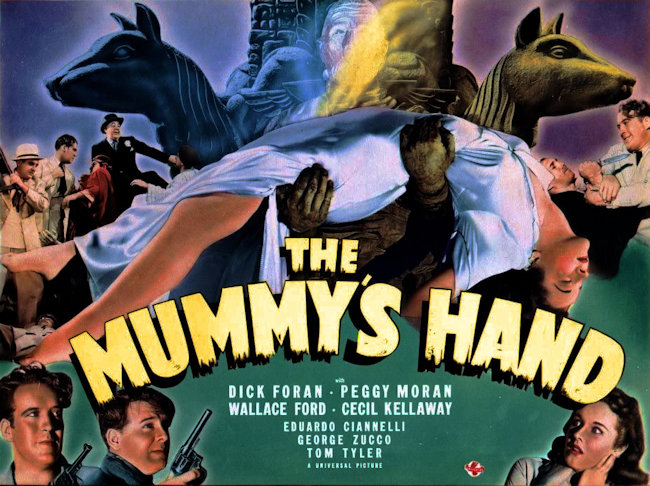
The story of …Hand is recounted at the beginning of The Mummy’s Tomb (1942) where the two guys responsible for the expedition that kicked everything off have returned to the USA and grown older.  Still holding a grudge, however, the wizard who knows when it comes to mummified corpses (George Zucco) sends his servant across to the land of the free with the body of Kharis to reap vengeance on those who caused all the trouble decades earlier.  The servant sets himself up as a graveyard caretaker while sending the mummy out to kill off the two clowns and anyone genetically associated with them, one by one.

This one really is a quickie: not only does it only run for an hour but the first ten minutes of that are taken up with a recap of the previous story, via flashbacks and the narration of Dick Foran’s returning character Steve Banning.  Universal also managed to bring in Lon Chaney Junior to play the monster (no doubt a consequence of his success in The Wolf Man a year prior), something he would do in the following two films also.  They also managed to annoy the star in the process by dropping the ‘Jr.’ from the actor’s screen credit, something which favourably distinguished him from his famous father in his eyes.  Chaney doing a moderate job does not hide the fact that there is little real challenge in characterisation with this creature, which is mostly shuffling around unable to remember why his leg and arm are out of use.  The make-up, though not as proficient as the first movie, is suitably putrescent.  Some of the stunt work is quite rough on the actors, particularly when it comes to fire.  Several people are dangerously close to the flames at the end and one actor (who visibly falls against his torch) was reportedly burnt during filming.  Neil Varnick’s story is quite feeble and lacking a certain amount of imagination, resorting to Universal’s obligatory mob of angry villagers for the film’s climax - quite strange because they’re carrying burning torches and clubs despite the time period somewhere around the middle of the twentieth century by my calculations based on the men’s ages, etc.  The early sightings of the creature bring about a number of amusing situations when he manages to avoid being seen in almost every instance with the exception of his shadow, consequently this giving rise to several reports of ‘a shadow’ in the area!  Imagine West Midlands police responding to reports like that… The entertainment factor here is diminished compared to the preceding chapters but the flick does retain a certain charm in its madness.

Some time after the events of …Tomb a group of hip students are learning history in The Mummy’s Ghost (1944) when the teacher decides to tell them about the mysterious mummy attacks that once allegedly took place in their very town.  Whilst it all seems a little difficult to digest, they don’t realise that the mummy inexplicably survived (indeed, it just wanders out of the forest near the beginning) and is soon on the move when the college professor experiments with the Tanna leaves that grant it strength and life - he is drawn to the leaves instinctively, killing the professor in the process.  The servant (John Carradine) of Andoheb (George Zucco again) has been sent on a mission to track down the body of Kharis’s ancient lover, which has been shipped to a museum in the USA, but realises when the body crumbles that her spirit has reawakened in the shell of one of the young student girls.  The servant decides that she must be ‘reacquired’ by Kharis.  I’m sure they were making this stuff up as they went along at this point!

By about half way through …Ghost I’d pretty much resigned it to being a worthless pile of camel waste.  Carradine’s acting is serious to the point of being about as active as a plank of wood, the mummy make-up seems to have been substantially cheapened (though Pierce was still involved, perhaps rushed), the story pedestrian and generally uninspiring.  There are even clumsy errors such as Chaney’s useless arm suddenly becoming functional when he needs to carry an unconscious woman.  However, the damn film almost won me over by its conclusion: why?  Because of that bloody dog!  This thing outshines Lassie when it comes to intelligence.  It’s only one of those small Jack Russell type of canines but, boy, is it smarter than the humans in this film.  It actually responds to their statements and even goes to fetch the mob of angry villagers when the two heroes are in trouble...!  Also, the denouement of the story is quite grim compared to virtually all other Universal monster bashes, and the outcome surprised me.  It’s not a good film by any stretch but the dog provided a few smiles (though whether those were intended is another matter) and the climax is the most effective of the whole series.

Shot around the same time The Mummy’s Curse (1944) took Universal’s tendency towards temporal distortion one step further, with some pub-dwelling gypsy-types retelling some of the last movie’s events as being about twenty five years prior.  Adding that up with the bodily aging of some of the previous characters, etc., this should place the time around the 1980s by my calculations, however it seems more like the turn of the twentieth century at the beginning before strangely shifting to 1940s America.  I don’t suppose chronological logic was at the front of the minds of Universal’s writers… Anyway, there are plans to completely renovate the marsh near Mapleton, where the events of previous films took place, when a couple of museum archaeological buffs turn up wanting to dig out the mummy and his bride Princess Ananka (after having been left there at the end of …Ghost) to return them to the museum.  Some of the locals are concerned that this interfering with the mummy’s current resting place will arouse the curse again, fears which aren’t without good cause it seems.  After dredging half the swamp they soon find an empty space in the mud where ‘a large man’ would have lain, and of course a dead villager nearby.  Oh yes, and the giveaway, there’s a bit of bandage left on the murdered person (I shit you not).  While Kharis is roped in by one of the Egyptian servants to kill more people, this time Ananka also reawakens to wander around in a state of perpetual confusion regarding her origins or purpose.

The problem primarily by this point was the fact that the stories really had nowhere to go and very much continually rehashed ideas from earlier films.  Quite literally too, as we were very often treated to flashbacks of footage from the other movies despite meagre running times.  The mummy, again played by Lon Chaney Jr., was a creature of limited potential and was lucky to have his lifespan stretched out over this number of movies.  The Mummy’s Curse begins more in the vein of many of Universal’s other films of the period, almost a timeless entity in a dimension undiscovered.  The murders themselves are quite feeble - one guy stumbles in on a ritual during the awakening of the mummy and very simply asks what they’re up to, like one would, before the mummy, which would have been plainly in his sight, staggers right up to him without him noticing until he‘s actually being strangled.  There is one standout sequence in this film, and indeed one of the best of the whole series; the revival of Ananka: she squirms awkwardly out of her grave, her eyes covered in mud and barely able to open, then staggers off in a manner that the TV girl in Ring would have been proud of.  It’s possibly the creepiest scene in the whole mummy series and director Leslie Goodwins must have realised he was on to something because he gets his mileage out of it.  Arguably she’s also more eerie than any of the titular creatures since the series began, other than perhaps the barely glimpsed Karloff creation that kickstarted the whole franchise.  Aside from the reawakening of Ananka, …Curse is a derivative and uninspired finale to the series.

There was of course one more appearance for the monster to come: Abbott and Costello Meet the Mummy (1955), which I will begrudgingly comment on here for the sake of completeness.  Having discovered an extremely valuable medallion (which Lou accidentally swallows), the duo – stranded in Egypt at the time - attracts unwanted attentions of a ‘Klaris’ cult and businesswoman who are similarly interested in the ingested artefact.  It all winds up in a showdown between the various medallion hunters and the revived mummy himself.

Clearly Universal itself had no faith in horror films in the fifties, nor its own Monster legacy (which would, most likely against their expectations, survive in the hearts of generations of fans until this day and beyond).  This alongside a number of other near-concurrent irreverent horror revivals in a comedy context are testament to that.  The two comedians had been making films together for over a decade by this stage, and faced up against various monsters of Universal’s past on several occasions.  This was presumably successful at the time.  …Meet the Mummy would be their last pairing against one of these monsters, and almost their last, period.  Throughout this film the pair amuse audiences by making fools of themselves as the creature proves ineffective as a killing machine, though at least it would return the series to its Egyptian beginnings.  The mummy doesn’t look at all good either, although a couple of differences to the five 1930s/40s outings manifest themselves, such a periodic use of vocal cords, and no limp or useless arm, which I would say is the only good thing about this iteration of the creature.  However, despite the advantage of four usable limbs, there is no murder or bloodshed to be found here.  From a personal point of view none of the comedy really works for me either, so this film is effective neither as a comedy nor a horror for me, and thus is my least favourite of the series, if indeed one counts it as part of the series.

The mummy films provide some fun overall (aside from, ironically, the Abbott and Costello outing), yet were clearly not greatly respected by its studio.  This is apparent by the haphazard manner in which the sequel stories were rushed together and the running times as meagre as the films’ respective budgets.  The mummy (actually Im-Ho-Tep in the first one, Kharis in the following four, and Klaris in the A&B entry) had minimal development as a character beyond the first film though at least there was some narrative progression and continuation from film to film, but within each context there was little to do for the monster other than stagger around and kill.  In a sense he is almost a precursor to Michael Myers of Halloween (1978 onwards) or the homicidal lunatic of almost any other long-running slasher series - this is possibly the slasher movie in its embryonic infancy here, formulating many of the staples that would much later on become clichés in slasher cinema.  Compared to Universal’s other series of the time the creature is less charismatic and quite a lonely entity.  The fact that his arm and leg are virtually unusable (unless he needed to carry a helpless woman) did irritate me a little throughout - he’s rendered practically impotent and the explanation for this was briefly suggested early on in the series but afterwards employed simply as a tool for having him walk in a (then) tension-building fashion.  The aforementioned temporal distortion is something that stands out if the viewer is to watch them in sequence, yet there is some inadvertent bewilderment to be had with this.  In fact, the series as a whole works at its best if you simply switch off the logical side of your brain and accept the crazy rules on their own terms.  Though idiosyncratic in the extreme, it can never quite match up to the studio’s Dracula, Frankenstein, and Wolf Man cycles.  It’s a pity that the gradually diminishing quality of the series detracts from its achievements; nevertheless, it is something that will provide a reasonable degree of entertainment, and that’s what it’s all about at the end of the day.

As a footnote, I’ve owned these on both DVD and Blu-ray, the latter representing a noticeable upgrade in clarity and contrast – these films look surprisingly sharp and beautiful considering their vintage (and the lack of respect Universal seemed to have for them, at least in the years following their production; it’s a wonder they even survived).  In the UK the whole series (including the lamentable Abbott and Costello fun-take) is available on Blu-ray in one neat, relatively inexpensive multi-disc package that takes up no more space than a single film.  I like the overall design of the cover, which fits in neatly with the other Universal Monster releases, sitting well alongside one another on the shelf.

Saturday, 19 March 2022

Lurking Fear

From Full Moon Pictures and released in 1994, featuring Jeffrey Combs, this appears to be an attempt to capitalise on the run of low budget Lovecraft adaptations that were semi-popularised with Re-Animator (hinted at just slightly by the return of Combs).  It was directed by C. Courtney Joyner (who?) and also featured the gorgeous Ashley Laurence (from Hellraiser of course, here credited on screen as Ashley Lauren).  It might be expected that this film bears only a very loose passing resemblance to the H.P. Lovecraft story of the same name, primarily retaining the underground creatures that tunnel around beneath a graveyard and up to a nearby building.  They're described as monkey-like in the story, some liberty again taken with this description for the onscreen version (although they do admittedly look quite good).

Obviously the timezone is quite different in Lurking Fear - brought into what was then the blissfully mobile phone-free modern day, it eschews the investigator of the story to bring in a bunch of crooks looking for some buried money in the aforementioned graveyard.  These guys (and woman) clash with a clan of people already battling the lurkers, and together they find themselves effectively trapped in the building while one half wants the money and the other just to bump off the creatures.  Gone is the lovely backstory of how the creatures came about, here only loosely connected to the main ex-con in terms of bloodline (and name).  The atmosphere of the story, a staple of many Lovecraft shorts, is largely lost.  I've never been sure why Lovecraft is not more often and better adapted for film, there is such a wealth of wonderful material available, and Lurking Fear is not nearly at the top of the pile.

88 Films brought a Full Moon equivalent Blu-ray to the UK market, featuring a reasonable 1.78:1 hi-def image with audio as good as you might expect from a low-budget mid-nineties production.  There are some soundless deleted scenes (odd that they were willing to excise anything given the relatively brief running time of the feature), one of those Videozone short making-of featurettes, a commentary and plenty of trailers.  The cover is reversible, providing you with the welcome option of displaying the sleeve without the intrusive BBFC logo, a persisting motif for a long outdated organisation that hangs on to its existence by overcharging struggling boutique labels for the right to sell their movies to a small British audience.  Lurking Fear has a few moments of interest, the presence of Laurence and Combs being the main selling points, but overall I would say viewing this will not set your evening on fire in the same way that, for example, Re-Animator or From Beyond would, but then you probably knew that.

Friday, 25 May 2018

Bride of Frankenstein

Taking some elements of the book that were originally left out of Frankenstein (1931), the 1935 sequel continues directly from the conclusion of the first film extending the story into something a little more complex.  Clearly the major omission from the 1931 adaptation was the creation of a mate for the abomination that had become a burden to its creator - a ploy on the part of Victor (here called Henry) to dispense of the creature once and for all from his life whilst simultaneously making amends, if such as thing were possible.  After the believed-dead Henry has been dragged back to his home and wife Elizabeth, his revival comes as a shock to all.  An old acquaintance visits the recovering man (bedridden partly because actor Colin Clive had actually broken a leg in real life at the time) with the intention of teaming up to continue experimenting with the creation of life, much to Elizabeth’s disapproval.  It seems the man, announced as Dr. Pretorius, has been developing in his laboratory a few miniature automatons of his own, something that seems borne out of a morally devoid mindset of obsessive, sadistic tinkering akin more so to that of a child than a scientist attempting to evolve mankind’s knowledge.  Initially defiant, Henry’s involvement is egged along by Pretorius bringing in the now obedient monster, something Henry thought to be dead after the windmill fire.  Elizabeth is kidnapped by the monster and Henry is forced to work with Pretorius to build a female, granting it life by similar means to the birth of his first ‘child’.  The monster himself is quite aroused at the prospect of a new friend after his first and only one, a wood-dwelling blind man, was taken from him by strangers.  Of course, the results of the female’s awakening are not predictable and her arrival is destined to bring doom to those around her.
Apart from filling in some literary gaps in Universal’s Frankenstein franchise the studio put together what some have since deemed to be the greatest horror movie ever made.  Yet this label often came from those who rarely watch genre products, and it can never live up to such heights.  Aside from that the film was certainly ahead of its era in many ways.  Englishman James Whale was nothing like the usual director employed to shoot mainstream films back in the golden age; he brought personality and style to his projects and was one of cinema’s earliest auteurs.  Look at any of his genre films and they stand out from the crowd: Frankenstein and the sequel reviewed here, The Invisible Man, and The Old Dark House.  In contrast to most directors of the period, Whale was not simply another employee on the film set.  One thing he brought to these darker outings, including Bride…, was a grimly humorous edge, something that was probably lost to the comprehension of studio executives in the thirties.  Much more pronounced here than in the first film it can take a while to get accustomed to nowadays (the squawking old woman who seems omnipresent still grates a little with me after many viewings), but it’s at least memorable, for example the monster puffing on cigarettes and acquiring a taste for wine is something that embeds itself in memory.  And then there’s that inexplicable laboratory lever…

Continuity is maintained with the first film quite well, bringing Colin Clive back as Henry, removing the monster’s burnt eyebrows as a result of the fire it had survived, the watchtower production design, etc.  Unfortunately, Mae Clarke would not return as Henry’s wife, however, she was replaced by the overly dramatic but innately beautiful Valerie Hobson.  Dwight Frye also returned despite his character being killed in the first film, this time in a role as a different person with almost identical functionality (that of an assistant). The increased budget (nearly half a million dollars) is reflected in an amazing laboratory sequence, the film’s pinnacle - a lovely marathon of drama, great shots and editing, culminating in the eponymous woman’s birth (or rebirth).  The combined motivations of Henry, Pretorius, and the monster itself all direct to this one event, their actions throughout propelled towards a singularity.  The monster simply desires a friend (though is innocently unaware of any reproductive urge that probably survives in his blood), Pretorius has a morbid, amoral fascination with experimentation in life engineering, while Henry wants his wife back, although it’s clear his own scientific intrigue is piqued once work begins on the bride.  Like the monster, the bride herself is a gorgeous, iconic piece of design, thanks to Jack Pierce once again I believe.  She doesn’t speak but clearly displays disgust as she first sees her predetermined mate, this in turn fuelling the monster’s anger that seals fate.  It was a small masterstroke to cast Elsa Lanchester as both the bride, and Mary Shelley herself in the film’s prologue (almost suggesting that Shelley identified with the bride when she wrote the story).  There was a similar epilogue shot eventually removed along with quite a few other scenes after test screenings; these are probably lost forever.

Certainly not the ‘greatest’ but a standout entry from Universal’s monster cycle and the genre as a whole when considering the thirties and forties.  James Whale did not return to the Frankenstein series again but Boris Karloff was to make one more appearance as the monster, several years later in Son of Frankenstein…

Saturday, 3 March 2018

Frankenstein (1931)

While an eminent vampire was crawling out of his crypt-bound coffin somewhere in Eastern Europe, a devout but possibly unhinged scientist was discovering the secret of granting life to that which has never lived…  Somewhat abbreviating Mary Shelley’s early nineteenth century novel, Universal’s first version of Frankenstein, or The Modern Prometheus warns us via prologue through an onscreen narrator of the ghastliness we’re about to witness (a tool Ed Wood would later naïvely employ in similar fashion with Criswell), before introducing Henry (though he was actually called Victor in the book) and his deformed servant Fritz as lurking body snatchers waiting for a recently deceased corpse to be buried over so they can exhume it in order to take it back to their laboratory.  Assembling a makeshift body from other people’s parts the scientist's last component required is a brain, but the imbecilic Fritz accidentally takes a damaged specimen from the nearby medical school after he drops the only good one.  This of course forms the catalyst for Henry’s eventual failure in creating a Nietzschean ‘superman’.  Using electricity provided by a storm the hulking monster is ’granted’ life but it proves to be sporadically violent, lacking observable intelligence and the means to integrate socially, unpredictable, and a moral burden to its creator.  Soon Henry is persuaded to go home and marry Elizabeth but he’s unaware that the creature has broken free of its prison and is now roaming the countryside.  The innocent murder of a child sparks a mob congregation, partly led by Henry himself, intent on tracking the wayward monster and destroying it.
Jack Pierce unwittingly developed one of the most iconic characters in cinema history with his creature design, painstakingly applied to Boris Karloff over a period of hours.  The bolts in the neck, the flattened cranium, darkened fingernails - all possibly thought of as clichéd nowadays but innovative at the time, and certainly possessing everlasting longevity.  The first proper appearance of the monster is strange, and partly achieved with a lovely piece of editing: footsteps as it approaches (and a verbal warning offered by Henry himself so our anticipation is heightened), the door creaking open, and the monster facing… backwards?  Yes, it actually walks into the room backwards before slowly turning for our first full view of it, a series of three or four cuts that progressively bring us closer to the distorted, morbid face.  This was the movie that really launched Boris Karloff’s career and seeing him in other films tends to bring it home how great this performance is; it’s an easy thing to forget through years of repeat viewings.  In fact I tend to prefer his portrayal of the monster here over his work in the sequel.  Bela Lugosi was famously offered the role, declining to become involved due to what he felt was an apparent lack of talent required.  This misjudgement is sometimes blamed on his later vocational misfortune but to be fair he’d already received plentiful recognition with Dracula and I doubt his future would have been significantly improved by taking on the role of the monster, firstly because his versatility as an actor would have inhibited his progression one way or another and secondly because he finally got his chance to play the monster a couple of films later for one of the sequels and it didn’t shake the world.  Having said that it’s impossible for anyone to predict what might have happened.

Henry’s dedication to his work is quite heavy handed, however, there is an omnipresent duality to his motivations: is his work that of a man who wishes to master science to create life through manipulating naturally evolving cells, thereby offering evidence that there is no God, or is he seeking to emulate the God that he believes exists (signified by his most famous line, “…now I know what it feels like to be God.”) so as to reinforce either his admiration or competitive contempt?  In fact, the name ‘Victor’ (the character's name in the book) itself may not have been chosen randomly in this light of theistic questioning: as indicated by the use of a quote from Milton’s Paradise Lost at the end of her book, Shelley was influenced by the poet and it is in this book that Milton refers to God as ‘the Victor’.  This possible allegory is unfortunately lost in the Universal film by their renaming the scientist as Henry.  Further characterisation of the protagonist comes when the monster is on the loose and we see Henry craftily lock his wife in her room - is this to protect her or because he doesn’t want her interfering, something which she has already done enough of.  Probably the former in this case but throughout the film there are thoughts in Henry’s brain we feel are remaining unspoken and this makes his character much more interesting.  Mention must also go to the castle/watchtower where Henry performs his experiments as it’s an incredible gothic design of twisted angles, warped walls and shadows, echoing some of the German silents that preceded it years before.  As a film it’s much better in many ways than its brother project, Dracula, released the same year, similarly successful and revolutionary.

Saturday, 22 July 2017

The Mighty Peking Man

Dating back to 1977, The Mighty Peking Man (AKA Xing Xing Wang) is a King Kong rip-off of the most shameless variety, however, don't condemn it just yet...  Hearing of a giant gorilla that supposedly lives on an Indian island, a group of wealthy Hong Kong businessmen set about capturing it in order to expand their ever-growing fortunes.  For this they acquire the services of a disillusioned, bummed-out anthropologist (Danny Lee), and set off for an adventure to locate the beast.  On the island they first find a scantily clad beauty who was left behind as a baby when her touring parents died.  Somehow she's managed to learn Mandarin in the process, as well as forging a relationship with the mighty gorilla.  She and Danny also develop the hots for one another, and before long the group have captured the ape and chained him to their boat (how they manage this part is conveniently skipped), taking him back to Hong Kong to be put on display like a gargantuan zoo animal.  Naturally, the ape breaks free and causes Godzilla-style havoc in the city.
Closely adhering to the plot of King Kong, the Shaw Brothers make a few changes to the story and process of bringing an oversized animal to the big screen, notably creating the ape by placing a man in a suit on miniature sets for much of the time (instead of time-consuming stop motion effects).  The girl of interest to the ape is not brought to the island either, as she was in the 1933 classic; here she's found almost as if she's a female version of Tarzan, and played by Russian blonde Evelyn Kraft she is almost too perfect for words.  She also possesses the amusing characteristic of not wishing to get clothed up (she does try on a few things on route to Hong Kong but promptly throws them out of the window in favour of her rag bikini!).  The monster gets angry enough to escape when he witnesses someone attempting to rape her (again, that never happened to Fay Wray!) and goes on the rampage that leads up to a climax that apes (apologies...) its inspiration.  The army, appearing with the sole intention of putting an end to all the mayhem regardless of morals, is led by a nasty westerner natch.  Aside from the prolonged frolicking love story element (which bizarrely features Kraft swinging around a leopard on her shoulders at one point), this is an action packed spin on the story, probably better than the 1977 US remake because it's a hell of a lot more fun.

88 Films have put out a dual edition Blu-ray/DVD of The Mighty Peking Man into a reasonably respectable package that preserves its original theatrical ratio in a clean, if a little grainless print.  Comparison between the two discs reveals, surprisingly, almost no difference in terms of raw detail, although contrast is noticeably different.  This may be an older master that's been supplied to 88, as I can't imagine something shot on 35mm in the seventies boasts maxed out detail on standard definition.  However, Blu-ray is not just about picture quality; it still wins out because the DVD is sped up for PAL, and the subtitles on Blu-ray are always more attractive to the eye than the blocky Spectrum-esque characters that plague DVD.  Audio is presented in two options, English or Mandarin (good English subtitles are available), and extras include a commentary by Bey Logan, and booklet that focusses on Danny Lee's cult career (written by Calum Waddell), with a little bit of a look at the film at hand here - apparently the booklet is limited to the initial print run.  The cover is also reversible and packed in a clear case (I actually really like the style of case they've adopted for the Asian Collection, which eschews the standard plastic header in favour of a full size cover).  Probably the best home video release of the movie itself, 88 Films continue to put out cult material of interest in the UK and extend their Asian range with a great addition.

Thursday, 16 October 2014

Frankenstein and The Monster From Hell

Locked up for dabbling with 'sorcery', a young doctor finds that he shares the asylum with his hero in science, Victor Frankenstein, who has faked his own death in order to continue with experiments and effectively control the weak-willed corrupt manager of the place.  Together the two scientists use various pieces of dead prisoners to construct a monstrosity that eventually awakens to produce dire consequences.

This film marked the end of an era for Hammer and horror films generally, as well as the career of its director and the man at the very birth of the studio's Frankenstein series, Terence Fisher.  The gothic literary adaptations and mutations of the 50s and 60s came to an interesting conclusion here, and they couldn't go on when across the water the Americans were delivering the likes of The Exorcist and Texas Chain Saw Massacre.  Frankenstein's monster failed to shock audiences any longer, although this particular epitaph was actually quite nasty in many ways, with some strong moments of gore and violence though oddly absent nudity (something which had become a staple of Hammer's output during the early 70s): the female lead, a mute played by Madeline Smith (The Vampire Lovers) remains fully clothed up to the neck throughout.  Peter Cushing, once again in the role of the baron, looks decidedly skeletal here but continues to deliver his usual perceptive portrayal of the character.  Taking FATMFH out of its difficult context in the history of horror it's not a bad film at all, with a beautifully grim setting (almost entirely in the asylum), an ugly, tragic creature at the heart of the tale, and some unprecedented brutality.
Released on Blu-ray in the UK as a dual edition pack, the three disc set contains two DVDs alongside the Blu.  On the Blu (and spread across the other two discs due to the substantially lower storage capacity of DVD) the film is presented as you would have seen it theatrically (my favourite ratio, 1.66:1) and, as an optional extra, in its un-matted 35mm form at 1.37:1 (i.e. more information seen at the top and bottom of the screen), accurately moving at 24 frames per second in either case (sped up to 25 fps on the DVDs, naturally).  Obviously if you're viewing on a 16x9 widescreen display then the 1.37:1 version will have thick black bars at the sides, whilst the 1.66:1 version will have very thin black bars at each side.  Preference will depend on the viewer ultimately, and one can argue the virtues of each until the full moon sets, but it's fantastic that we're actually given the choice and the viewer can sample each before settling down to the enjoy the film.  Detail on the 1080p Blu-ray transfers is set at an excellent standard, whilst the DVDs can't compete but still look reasonably good considering they're Standard Definition.  On the audio side, the mono (uncompressed LPCM on the Blu-ray, compressed Dolby Digital on the DVDs) is clear and as decent as you can expect.

What else do you get?  There's a commentary track with two of the main actors (Shane Bryant, who plays Frankenstein's protégé, and Madeline Smith) moderated by classic horror lover Marcus Hearn.  Secondly you get a great documentary directed by Hearn about the making of the film, with plenty of interviews from surviving participants incorporating some enticing anecdotes about Cushing (including some images of his extensive notes on the script).  This runs for 25 minutes.  The next documentary focuses on the director himself, again a fine piece and this time running at 13 minutes.  A 7 minute animated gallery features shots from the set, some lovely posters/advertising materials, promotional stills of the likes of Smith, make-up work-in-progress of the monster (David Prowse), etc.  All of these extras are on both the Blu-ray and one or the other of the DVDs, the only extra remaining that is not on both is a PDF of a 30 page booklet, which is only on the second DVD and accessible via a PC of course.  I would have preferred a printed version of this but I guess they saw this as a cost-cutting measure.  There's a lot of information about the production of the film and reactions to it post-release, and overall it's a nicely presented companion.  The booklet also goes into significant detail on how the film was restored for high definition presentation, and makes one appreciate the work involved.

The initial pressing of this Icon-released set back in May 2014 was flawed with some stalling issues on the Blu-ray.  This was corrected quite quickly and the versions available now are fine to watch, resulting in this now being the definitive presentation of quite a reasonable and gruesome latter-day Hammer.

Sunday, 17 February 2013

The Fly

1986, US / Canada, Directed by David Cronenberg
Colour, Running Time: 96 minutes
Review Source: Blu-ray, Region B, Fox; Video: 1.85:1 1080p 24fps, Audio: DTS HD MA

Is there anyone that hasn't seen David Cronenberg's The Fly remake? In an age where remakes have swamped the cinema release schedules over the last ten years or so, this film is an overwhelming demonstration of what can be done with someone else's previously filmed material. Taking the core story of the Vincent Price 1958 original, the 1986 version of The Fly is brought up to date for the (then) modern era in terms of technology, science, and sheer gruesomeness. It's the story of a scientist who has cracked the teleportation problem, and in testing the machine (two pods, whereby the molecules of the one are disintegrated and reintegrated into the second) he goes through unknowingly at the same time as a house fly that has unfortunately landed in the pod prior to the teleportation. The computer confuses the two organisms and effectively splices them together at a genetic level, thus beginning a progressive transformation of the man into a horrific amalgamation of the two. What sets Cronenberg's story apart from the average monster movie, partially, is a particularly strong emotional foundation. Brundle's degeneration into disgusting monstrosity, the product of his own relentless curiosity and drive to push science forward, is ultimately tragic and believable. There are five stars of this film in my opinion - firstly, David Cronenberg of course, who continued his exploration of mutations of the human body on a thematic level, in the process creating one of the greatest remakes in cinema history. Then there is possibly the most talented composer in the film (and probably non-film) world, Howard Shore, whose score pounds home Cronenberg's themes at key points, building momentum to the devastating climax. The next two are Jeff Goldblum and Geena Davis, whose performances bring all of this together in a gripping fashion. Finally, there is Chris Walas' awe-inspiring creature effects, which are still repulsive to this day. There are a couple of moments that seem to be there purely for shock value more than anything else but the result of Brundle's dabbling is like a nasty car crash - you kind of can't take your eyes of it despite the fact that it's not at all nice to look at. The stilted dialogue of the early scenes is not to be off-putting - the film develops itself into a classic of the horror/science fiction hybrid (appropriately) genre.
I've seen this film on most home video formats and have more recently picked up the Blu-ray Disc, promptly selling the DVD. Video cassettes of this film looked awful - very muddy and indistinct. DVD was noticeably better, but the film's rough look has made it difficult to translate to the lower resolution of VHS and DVD. The Blu-ray is significantly improved - in lighter scenes the detail is very strong, colours are far more realistic, and the contrast is better balanced. Darker scenes still look quite rough, but it's probably easier to see exactly what's going on now. There are details on the creature effects that I'm sure I never saw before on DVD. Overall, it's definitely worth upgrading to the Blu-ray for full HD image quality alone. The audio track is serviced by a lossless DTS-HD surround track - most of the sound comes from the front, particularly centre, channels, but the music is embellished with the greater resolution and very welcome impact. It is limited by 80s recording technology and that's never going to change, but it sounds better here than it ever has. On the disc you also get the extras of one of the former DVD special editions (the set I originally bought had The Fly II on an extra disc, but of course that isn't included here). That includes director commentary, documentary, deleted scenes, and loads more. For fans of the film, you have to pick up this very strong Blu-ray and ditch your old DVD/laserdisc/VHS as soon as possible.

Thursday, 3 January 2013

Possession

1981, France/Germany, Directed by Andrzej Zulawski
Colour, Running Time: 123 minutes
Review Source: DVD, R1, Anchor Bay; Video: Anamorphic 1.66:1, Audio: Dolby Digital Mono

Genre amalgamations go back a long way, whether it be the obvious mixing of science fiction and horror abundant during the fifties, or gangster/vampire combinations such as From Dusk Till Dawn, etc. From what could easily have been the uninspiring and unproductive event of marital break-up in the life of Zulawski was borne Possession (not the one with Gwyneth Paltrow in it!) - something that might be described as an odd collision between social drama and visceral horror. Sam Neill and Isabelle Adjani play Mark and Anna, a couple in the midst of a marital crisis where permanent split seems like the only viable outcome. Aside from having a young child to consider, Mark appears to be unable to live without Anna but has difficulty communicating what he’s feeling without descending into maniacal, emotionally charged babbling, often turning to manifested aggression in frustration. His psychological state spirals downward while Anna seems ambivalent about what she truly wants, often portraying a need to terminate the relationship between them whilst possibly still exhibiting some feelings that are positive towards her husband, amidst the obvious torrent of confusion. Mark finds out that she’s been having an affair with someone and naturally this does the situation no favours. Finding out who it is he goes to see the man, presumably without intention to discuss the problem diplomatically - the strangely androgynous Heinrich beats Mark up during the ensuing conflict. Arranging to have his wife followed it’s revealed that Anna is frequently retreating to a derelict area of the city (Berlin) where in a run-down apartment she’s mating with some sort of hideous multi-limbed monster.
Rather than being a story of demonic infiltration à la The Exorcist, this movie investigates the results of the ‘possession’ of one human being by another, something that generally occurs in intimate relationships and is suggested here to ultimately have a destructive effect on its closest participants. The film distributors, particularly in America, didn’t really know how to market this project and in all fairness that’s quite understandable, especially in an era when films of a fantastically disturbing nature were good box office business - not only is the trailer a superficially ambiguous advertisement for what could easily be just another monster movie in its audience’s eyes, but the film itself had forty minutes or so removed by a studio who didn’t understand the content. Similarly here in the UK it was placed on the banned list by the Director of Public Prosecutions and effectively condemned as a ‘video nasty’ (something that ironically probably helped gather a small cult reputation for the film). The film has since been restored in the US and permitted an uncut release in the UK under thankfully revised opinion. Controversies aside, what remains now though is something that’s difficult to understand with its apparent symbolism and personal meaning to the director. It’s clearly a response to the despair produced by the disintegration of his own relationship with his spouse but there is much here to decipher, and that’s where many viewers will drop off (to sleep in some cases). However, there are rewards to be had should you be able to mentally focus on what’s going on - the intricacy of Mark and Anna’s relationship is disturbingly realised and the physical product of their interpersonal deterioration is quite fascinating; that is, the terrifyingly passionate hatred between them seems to create the very monster that Anna ends up mating with (thereby producing more offspring). The creature itself is not seen too much but what’s visible is hideous, a bedridden octopus-like monstrosity that conceals something distortedly human in its nature. Anna’s occasional dismissal of her real husband hints at the possibility that she (i.e. the female) sees him purely as the machine that will impregnate her when required. The fact that she’d rather mate with something so horrific (than her husband) in order to produce more offspring possibly offers support to this idea. While Neill does a good job Adjani is simply astounding as Anna. The extremity of emotions she displays is worryingly realistic (indeed she won a couple of awards for this role), most notably in the train tunnel sequence where she goes into prolonged violent spasms before a disgusting miscarriage - this scene must be one of the most disturbing ever committed to celluloid, surely something very few actresses could have achieved, and it pretty much elicited outrage in some people. Its impact is profound and underlines the state of Zulawski at that time. As far as the film as a whole is concerned it's more likely to be a painful experience rather than a specifically enjoyable one, but the latter was hardly the director’s intention.  Plus I would suggest that it is excessively long at two hours. However, films don’t come a great deal more challenging than this and its imagery and overall impact is quite unique.

Released a couple of times in the US by Anchor Bay Possession was restored to its full running time and Zulawski’s original vision, plus it was presented correctly at 1.66:1, anamorphically enhanced in a pillar-box fashion and generally pretty good looking for its time. The DVD also came with director commentary and interesting text notes on his work. The second disc release was identical apart from the fact that it was coupled with Mario Bava’s final film Shock as a double-bill.  Possession was finally passed uncut for home viewing in 1999 by the BBFC here in the UK for a Visual Film Entertainment VHS, and Second Sight have since (in 2010) put out the film on DVD - this UK DVD is the best edition of Possession available at time of writing, presenting the film uncut in the correct aspect ratio (as did the Anchor Bay DVD but with a much more comprehensive selection of extras, albeit missing the AB commentary). More recently US company Mondo Vision have been preparing their own special edition DVD of the film, reportedly with around four hours of extras in addition to being available in either standard SE or limited SE sets, but I suspect the cream of all releases will come from Second Sight this year, who are putting together a Blu-ray consisting of a director-approved HD transfer and host of newly commissioned bonus materials as well as the ported over extras from their 2010 DVD.

Monday, 26 November 2012

Leviathan

1989, US/Italy, Directed by George P. Cosmatos
Colour, Running Time: 94 minutes
Review Source: VHS, PAL, CBS/Fox; Video: 1.33:1, Audio: Stereo

A deep sea mining expedition is thrown slightly off schedule on the discovery of a sunken Russian ship that is reportedly still floating around the ocean as part of a larger fleet - it looks to the crew like it was torpedoed. A remote investigation results in the crew bringing back a stash of items, including a frantic Russian captain's final log (luckily the rig's doctor speaks fluent Russian...) and some alcohol. After sneakily taking a few sips of the quickly confiscated drink a couple of the crew fall ill with skin rashes and nausea, soon after one of them dying in a rather gruesome fashion. Then his corpse begins to mutate before the team leader decides to get the body off board before any infection spreads - but whilst they do manage this, they don't initially realise that a prehensile organism remains on the rig, and it's continuing to mutate at an alarming pace.
Clearly Leviathan was inspired by the likes of Alien and Aliens, throwing in elements of The Thing and Forbidden World just in case anything was missed. In this respect it's not remotely original - the plot is structured in order to lead to anything that was good about those other films, the characters are cut and paste jobs from any Hollywood action film of the period (with nicknames like 'SixPack' and hip - for the 80s - dialogue such as 'go suck on a squid', or something like that), and it features a disgustingly forced 'surprise' climax where you thought it was all over but, hey, it's really not! Aside from all that it's fairly easy to watch, with some lovely effects work from one of the 80s masters of prosthetics, Stan Winston - very gooey and disgusting despite the final monster not quite coming off so well. There are a number of name actors on board - post-Robocop Peter Weller doing a very good job as the skipper, Amanda Pays there to look good (though strangely her character takes showers with her bra and panties on... well at least it saves on washing!), the freaky looking Meg Foster as the bitch who actually gets her comeuppance, Daniel Stern as the prerequisite overly sexed stereotype male - but this is really a B movie at heart, and should only be viewed as such. Jerry Goldsmith is also there to give some credibility to the whole show, although his score is strangely generic. Coincidentally he also scored Alien but the material here invokes no emotion whatsoever - for a man who composed such stunning scores as those for The Omen and Total Recall this is a shame. Still, for monster movie fans this is a sci-fi horror (whose director was best known for Rambo: First Blood Part 2) that will pass some time relatively painlessly, if you don't pay too much attention to its shortcomings.

Re-watching this old video cassette makes one appreciate DVD and Blu-ray again!  The picture is horrifically cropped (from a J-D-C Scope ratio) to 1.33:1, sometimes requiring visible scanning to get essential visual information into view. Colours are washed out and detail vague. What colours are there tend to bleed, especially during the end credits. Audio is servicable. There have been a couple of DVDs released of the film over the years in the US and Europe, however it's surprising to note that there has never been a UK release (to my knowledge). I suspect this film would fare a little better presented properly, though it will never be considered essential.

Friday, 19 October 2012

Piranha

2010, US, Directed by Alexandre Aja
Colour, Running Time: 88 minutes
Review Source: Blu-ray, Region B, EIV; Video: 2.39:1 1080p 24fps 3D, Audio: DTS HD

An earth tremor releases from beneath the ocean thousands of prehistoric piranha with a particularly ferocious carnivorous attitude towards humanity, just as Lake Victoria, situated nearby, is entering into its party season as hundreds of promiscuous American teens with great bodies consume alcohol and abandon all respect for peace (and themselves). Aja's second remake of a classic seventies American B movie (the first being the rather brutal Hills Have Eyes), Piranha has its tongue in cheek and is spattered with homage to exploitation cinema - both in its contemporary form and the glory days - from the outset, including Richard Dreyfuss murmuring the tune he sung in Jaws (before being stripped of all flesh in the prologue), a cameo from Hostel director Eli Roth, and mountains of extreme (but fun) gore interspersed, surprisingly, with copious nudity. The film is not subtle, nor is it original, nor does remotely attempt to apologise for any of this. It does apparently boast remarkably high production values considering it's aiming itself firmly at the primordial instincts of its intended audience, with a great look, underwater sequences, soundly executed action set pieces, lots of digital and prosthetic effects (not all of which are entirely convincing, but that doesn't seem to matter in the context), some decent actors (amongst them, Ving Rhames, Christopher Lloyd and Elizabeth Shue - notice I haven't included Kelly Brook in that list!), and of course the fact that it was shot/mastered in 3D, which isn't cheap. There is a touch of anchoring the narrative on a main man, this being TV star Steven R. McQueen as Jake (here reminding me a little of the uptight Lee Montgomery character in Mutant), the nerdy boy who's inevitably going to become some sort of unlikely hero by the close credits. Despite this the film spends as much time as possible on everything else, namely fish ripping people apart and hordes of chiselled human bodies with little or no clothes covering them. And, boy, do these people deserve what they get! I am a bit sick of remakes nowadays but this one cooks up loads of enjoyment, from thrills to laughs, and I think you'd have to be in a pretty miserable mood not to have a nice time.
The Blu-ray serves up every conceivable viewing option, from conventional 2D, anaglyph 3D and Real 3D, the latter requiring appropriate 3D equipment of course (this being a 3D TV/projector, a 3D Blu-ray player, and a v1.4 HDMI cable). The anaglyph version can be viewed on conventional Blu-ray equipment, but it's really not worth it - whilst there is a 3D effect evident, the technical nature of the process (i.e. red'blue cardboard glasses, of which EIV have kindly supplied several pairs!) renders the natural colour scheme of the film a complete mess. I've viewed the 2D version in its entirety and the visuals look wonderful from start to finish, of particular note being the unbelievably vivid colours and immense detail. Having now acquired the aforementioned 3D equipment I've finally got the opportunity to watch the 'proper' 3D version. Thankfully the aforementioned vivid nature of the 2D presentation is retained, but the added third dimension really makes this dazzle! There is the odd flaw (for example, cross-talk, where one eye mistakenly picks up the image intended for the other eye, plus some fast moving material that's difficult to perceive properly) but generally this is a powerful experience, enhancing the somewhat limited essence of the source material. Two English audio tracks offer surround DTS-HD Master Audio to lift you out of your chair if you have a 5.1 or 7.1 set-up, or two channel Dolby Digital, which sounds unexpectedly good on a reasonable sounding TVset (I've listened to each track on a decent surround kit and a TV respectively). A stupendous showcase for Blu-ray overall, and a film that's not taking itself entirely seriously in its efforts to roll you along its kinetic rollercoaster ride. Hell, looking at the poster attached, even the German's seemed to get it!